
A business fronting a franchise offers a form of comfort. It provides the impression that the company manages the operations. It provides the assurance that there is a corporate department that manages and oversees the necessary operations and the local laws and regulations. In light of this, if a franchised convenience store or grocery outlet has SNAP benefits, there is a legitimate concern about what happens if something goes awry.
Many prospective franchise owners are shocked to find the answer is that it is not the brand, nor is it the corporate office. As is the case with most franchises, SNAP compliance is the responsibility of the franchisee.
This guide explains who is responsible for SNAP compliance for a franchised food outlet. It provides clarity to how franchised food stores are authorized, the role of the franchisor, and how to develop a system to protect your EBT benefits.
What SNAP Compliance Means for a Franchised Store
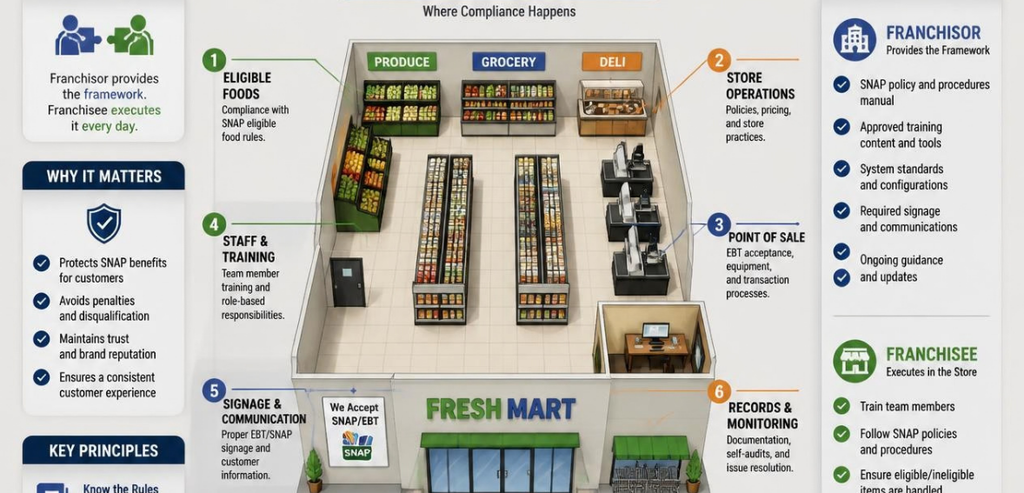
SNAP stands for the Supplemental Nutrition Assistance Program. It lets low-income households buy eligible food using an Electronic Benefit Transfer (EBT) card. More than 40 million people redeem these benefits each month. Retailers that accept them play a direct role in feeding those families.
SNAP compliance refers to the required guidelines for a store to continue accepting SNAP benefits. These guidelines include restrictions on what products a store can sell through SNAP EBT, required procedures for stores to process SNAP EBT transactions, training requirements for store employees, and record-keeping requirements. Additionally, SNAP compliance guidelines outline what a store can never do. For example, SNAP compliance guidelines prohibit stores from exchanging SNAP benefits for cash.
SNAP compliance guidelines apply equally whether a franchised food store is operated as a national brand or not. That means the store is required to comply with all federal standards. That is the essence of franchise SNAP compliance. What SNAP compliance guidelines dictate is that regardless of how large a parent company might be, each store is permitted to operate as a single authorized retailer.
The Short Answer: Who Owns Franchise SNAP Compliance?
The franchisee owns it. Full stop, in most cases.
SNAP authorization is issued to a particular firm at a particular location. When your firm applies to accept SNAP, you list your business entity and its owners. You accept SNAP terms and conditions. You assume responsibility for your actions and those of your employees. This responsibility extends to your store’s paid and unpaid workers, full-time and part-time employees and family members.
The franchisor generally does not hold the SNAP permit. Therefore, the franchisor is not generally the government’s violation target for your location. Your franchise agreement may allocate obligations to the respective parties. However, in terms of federal enforcement, the burden of responsibility lies with the store owner.
How SNAP Authorization Works and Why It Matters for Franchises
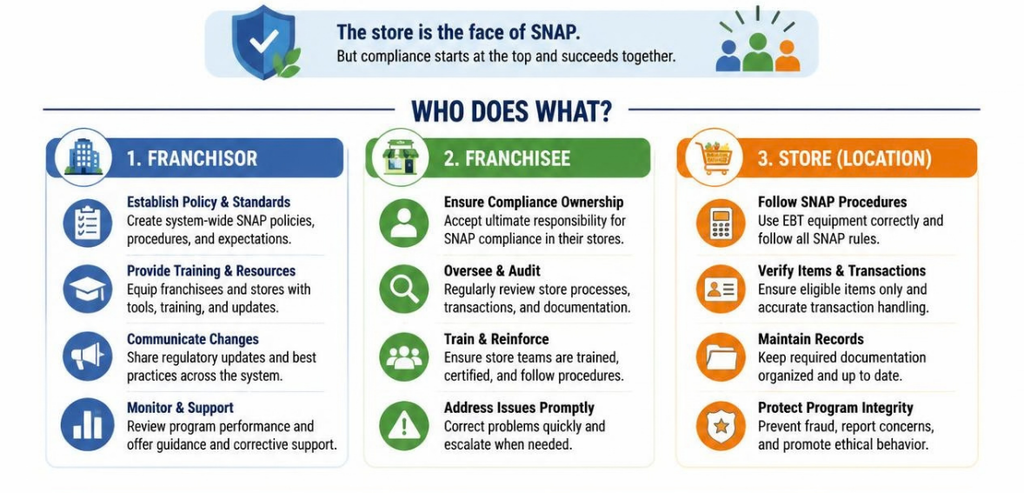
You cannot flip a switch and start taking EBT. A store must be authorized first. This step decides, from day one, who owns franchise SNAP compliance.
USDA Food and Nutrition Administration (FNA)
The federal agency that runs SNAP retailer oversight was long known as the Food and Nutrition Service (FNS). As of June 1, 2026, it became the Food and Nutrition Administration (FNA), part of the U.S. Department of Agriculture.
The FNA has the exclusive authority to approve retailers for SNAP. No other entity can provide this service to you and there is no charge for the application. The process involves filling out an online application, providing your ownership information, and undergoing a background check. For those with previous SNAP fraud, owner authorizations are denied, so thorough applicant reviews are conducted.
After approval, a SNAP permit and FNS number are issued. The permit displays the store name and location, including the owner(s). Because permits are issued to individual owner(s), this is why the franchisee, and not the corporation, is responsible for compliance. The retailer overview is available on the USDA SNAP retailer page.
Since the authorization is granted to the local entity, a franchisor does not have the ability to “cover” your store under a master license. Every franchised store that intends to offer EBT must obtain authorization on its own. Every store is responsible for their own compliance.
Franchisee Responsibility: The Owner on the Permit
Your name is on the permit, so the buck stops with you. That single fact drives almost everything about franchise SNAP compliance.
You have thirty days from the date of a hire or authorization to complete and document training for every employee. To avoid compliance issues, you will need to institute an operational policy. You are required to maintain inventory for the mandated staple foods, ensure only eligible purchases are scanned for your customers at the EBT checkout, and maintain accurate records for these transactions. The USDA policy mandates retailers retain these records for a minimum of three years from the date of the transaction to accommodate auditing.
You are still responsible, even if you were not operating the register at the time of the violation. EBT benefit trafficking or sales of non-compliant goods by your employees are grounds for the government to take action against your business. Being unaware of the violation is not an acceptable defense. This type of “strict” program accountability is the norm for federal programs. This type of program surety and compliance is why it is so important to run your program and to perform regular, documented training for all employees, using the resources available on the USDA SNAP Retailer training page.
Where the Franchisor Fits In
The franchisor is not absent from the picture. It just plays a different role. A brand sets standards. It may require a certain point-of-sale system, a certain product mix, and certain signage. Some of those brand standards directly shape how well a store handles SNAP.
Yet the franchisor usually does not hold your permit and does not answer to the FNA for your daily transactions. Think of the brand as the architect of the building and the franchisee as the person who must keep the doors locked at night. The design matters, but the owner carries the day-to-day duty.
Vicarious Liability and the Franchise Agreement
There is a small exception you should be aware of. A franchisor can have “vicarious liability” if they heavily influence controllable daily activities. Brand influence over hiring, training, setting prices, and management is what the courts examine. They also examine the influence over the public face of the business.
You will see this theory in lawsuits far more than you will in SNAP enforcement. That being said, a franchising contract can assign different aspects of a business to different parties by contract. A brand can offer Point of Sale (POS) support and/or assistance with compliance. A franchisee can agree to adhere to every program. Those contract terms determine the financial burden if something goes wrong. They do not alter the status of the authorized retailer. To understand how these duties are divided, the UpCounsel liability in franchising guide is a good starting point.
Everyday Franchise SNAP Compliance Tasks
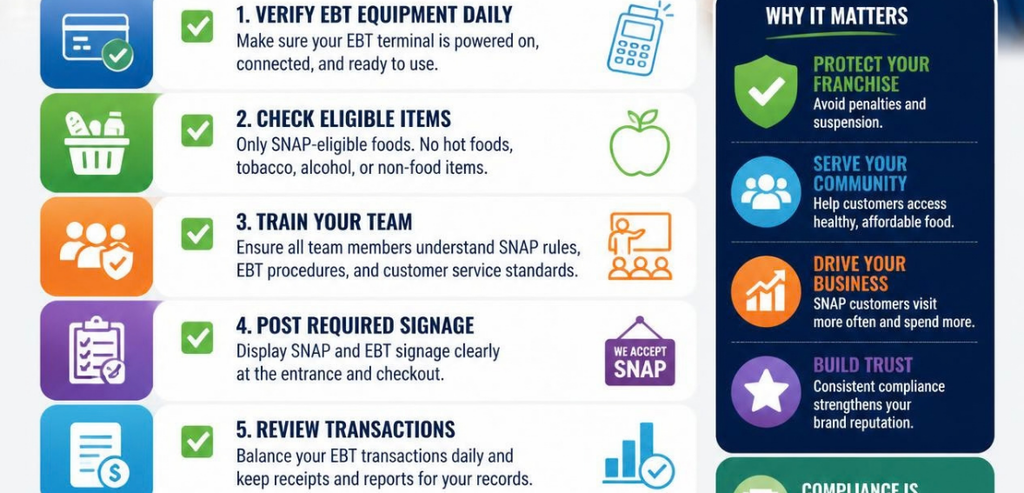
Owning compliance means owning the small stuff, every single day. The routine matters more than any one policy on paper.
The largest recurring risk occurs at the register. Your system needs to separate SNAP-eligible food from ineligible food. Both are usually found in the same basket. Your point-of-sale system needs to process a split tender sale, charging SNAP for the portion of the basket that is SNAP eligible, while the remaining portion prompts another payment. Considering each item as SNAP eligible quickly makes your system a liability. It can cause violations of overcharging which would jeopardize your system’s authorization to operate.
Stocking is the other constant. There are new SNAP food stocking standards that take effect November 4, 2026. These raise the stocking requirements for most authorized retailers. Franchisees will need to check their shelves for compliance with the new standards. The FNA conducts site visits for authorization, reauthorization, and investigations to ensure compliance with these standards.
Then comes the human element. Post the required “Report Abuse of SNAP” poster where it is easily seen by shoppers. It is also important to ensure that training records are up to date. Be on the lookout for cashiers who are being noncompliant. Franchise SNAP compliance is dependent on these practices.
What Happens When Compliance Breaks Down
Consequences can be mild or severe. A letter of warning may be issued for an initial, minor infraction. A first infraction selling small ineligible items that would include, for example, disposable paper plates or plastic eating utensils would result in a six month disqualification. Temporary disqualification of Electronic Benefit Transfer (EBT) services and civil monetary penalties may be imposed for repeat infractions or obvious systemic violations.
There is a permanent disqualification for the trafficking of benefits for cash, as it is a federal offense. As a consequence, prosecution is inevitable, and SNAP benefits would be permanently revoked. For stores that serve low-income customers, losing EBT may quite literally mean the end of the store. The FNA administers these penalties directly, and there is little discretion or relief once a disqualification is final.
Building a Franchise SNAP Compliance Program
A well-structured program protects your SNAP permit and your business. Consider the SNAP permit a personal responsibility and not a benefit to the business. Write a compliance policy and review it regularly. This policy should be used to train every new employee within 30 days and all employees regularly. Point-of-sale systems that automatically flag eligible items that allow split tender sales should be your system of choice.
Work with your franchisor instead of assuming they handle it. Write to them to clarify who is providing point-of-sale support and who is providing eligibility data updates. Maintain three complete years of compliant data. Always be proactive and especially if new stocking standards are put in place. If you take a proactive posture towards SNAP compliance regarding your franchise and business, it will never become a crisis.
Conclusion
So, who owns SNAP compliance in a franchised food store? The franchisee does. Authorization attaches to your firm and your name, not to the brand above the door. The franchisor can shape standards and share duties by contract, and in rare cases may face liability through heavy operational control. But the government looks to the authorized retailer, and that is you.
Treat that responsibility with the seriousness it deserves. Train your people, control your register, stock the right shelves, and keep honest records. Do that, and franchise SNAP compliance becomes a routine you manage rather than a threat that manages you. Your permit, your revenue, and the families who shop with you all depend on it.
Frequently Asked Questions
Is the franchisor ever liable for a SNAP violation at my store?
Usually not, because the franchisor does not hold your SNAP permit. The authorized retailer answers to the USDA. A franchisor could face liability in a broader lawsuit if it exerts heavy control over operations, and a franchise agreement can shift some duties by contract. But federal SNAP enforcement targets the store owner named on the authorization.
Can I use my franchise brand’s authorization instead of applying myself?
No. Each franchised location that wants to accept EBT must secure its own SNAP authorization from the Food and Nutrition Administration. No master license blankets every franchisee. This is a core reason each owner holds their own compliance record.
What is the fastest way to lose my SNAP authorization?
Trafficking, which means exchanging SNAP benefits for cash, is the fastest route. It can trigger permanent disqualification and criminal charges, even for a first offense. Selling ineligible items and repeated smaller violations can also lead to disqualification over time.
Am I responsible if an employee breaks a SNAP rule without my knowledge?
Yes. As the authorized retailer, you are legally responsible for the actions of everyone who works in your store, whether paid or unpaid. That is why documented training and active supervision are central to any franchise SNAP compliance program.