
Picture a shopper walking into your store with a short list. Milk. Bread. Eggs. A can of beans. They only have a few minutes. If they can’t spot those basics fast, they get frustrated. Some ask a clerk. Others just leave. That small moment of confusion costs you a sale, and it quietly chips away at trust.
This is where aisle cues become beneficial aids. Innovative shelf designs and smart use of color reduce searching time for staple foods. This leads to finding foods more quickly, resulting in higher store visits, increased purchases, and repeat visits. For stores that sell food benefits, findability helps, but is more important for compliance and community access.
Next, we will explain how to improve findability for staple foods. We will also explain why retailers struggle with findability and how effective SNAP staple food merchandising improves findability.
What Are Staple Foods, and Why Findability Matters
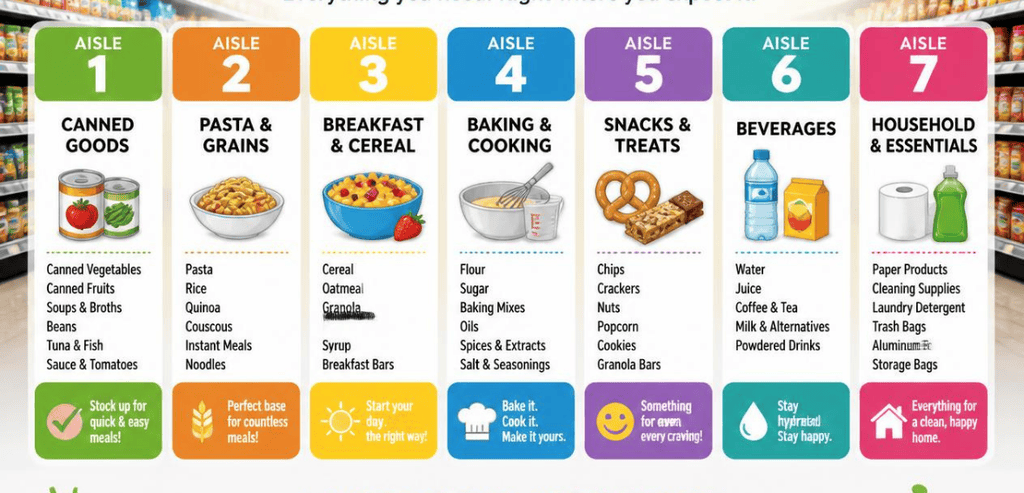
Staple foods are the basics people cook and eat as a meal at home. Think fresh produce, meat, dairy, and grains. They are not snacks, candy, or hot prepared foods. The U.S. Department of Agriculture groups them into four core categories: meat, poultry, or fish; breads or cereals; vegetables or fruits; and dairy.
These components comprise a balanced diet. They also explain why many customers will visit your store. No one makes an effort to visit your store just to buy chips. Customers visit your store for the basics and buy additional items along the way.
This creates great importance for findability. A customer who can easily find the loaf of bread and eggs sees your store as good. The opposite is true for a customer who has to wander your store in search of the items. Research shows that most customers visiting a store have a time constraint. If your store has what they consider to be essential items, they will locate and ask a staff member. If they can’t find what they need, they will leave the trip empty-handed. Neither of these outcomes is ideal for your store.
The Merchandising Gap: Why Staples Get Lost
Here is the uncomfortable truth. Most stores are not designed to help you find staples. They are designed to slow you down.
This is the merchandising gap, the difference between customer needs and shelf organization. Retailers often hide staple items. Eggs, bread, and milk, for example, are often put in the back of the store. This is done because the longer the distance to the needed items, the more likely people are to buy additional, non-essential items.
Shelf height also influences customer buying behavior. Anything at eye level is likely to be the first thing a customer buys. This is because this shelf ‘space’ is at a premium, and brands will pay retailers, via slotting fees, for this shelf space. This high shelf space is generally occupied by high-profit items, leaving only low-profit items to the lower and upper shelves, which, in effect, is also occupied and therefore remain ‘unseen’ by most shoppers.
This is also not out of the ordinary. Most stores are designed this way. However, this will frustrate your loyal customers because for the sake of ‘impulse buying’ in designed stores, items essential to budget and even health-conscious customers become obscured. This is where the merchandising gap is less of a burden. A store that ensures staple items are accessible will optimize its design in a way that loses nothing to impulse buying.
SNAP Staple Food Merchandising: What the New Rules Require
For any retailer that accepts Supplemental Nutrition Assistance Program benefits, staple foods carry extra weight. Federal rules set a minimum for what you must stock, and those rules are getting stricter.
In May 2026, the USDA finalized rules on stocking standards. Retailers have until November 4, 2026, to comply. Grocery stores authorized to accept SNAP benefits will now have to offer seven options in each of four categories, up from the previous three. Each of these varieties will have to have at least three stocking units, and at least one perishable variety will be required in three of the four categories.
What does this mean for merchandising? Stocking the items is only half of the work. Presentation is the other half. Merchandising regulations and customer expectations make it essential for stores to show that SNAP staple food items are present and accessible. A store filled with candy and snacks that places the SNAP staple food items on a dusty shelf is poor merchandising.
Merchandising of SNAP food items requires that food categories get ample space and easy-to-notice signage. Perishable items must be readily accessible. This is particularly important for the merchandising of food items in convenience stores that have relied on sales of snack and grab-and-go items. There has to be a shelf and refrigeration redesign to support the basic food items and to make them easy to locate. Good merchandising protects your SNAP authorization and fulfills the needs of your customers.
Aisle Cues That Make Staple Foods Easier to Find
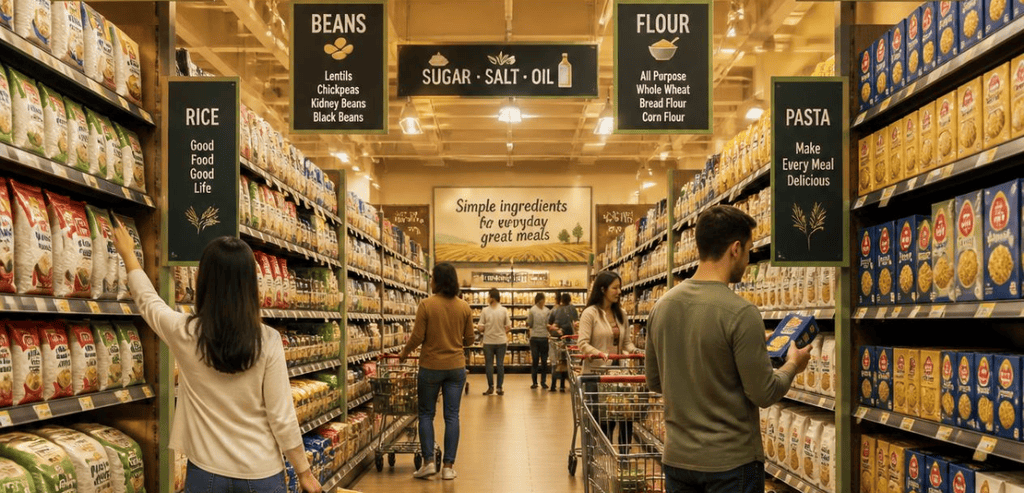
So how do you actually guide a shopper to the beans and rice? You use layered visual cues. Good stores signal from three distances at once. A category banner catches the eye across the room. An aisle sign confirms the section from a few steps away. A shelf label seals the deal at arm’s reach. Let’s walk through each layer.
Overhead Category Banners and Aisle Blade Signs
Start high. Banners and aisle signs that are visible before shoppers enter a section should describe the broad category in large letters. Shoppers often notice the words “Dairy,” “Bread & Cereal,” and “Canned Vegetables” before entering the aisle and help direct them to the right aisle.
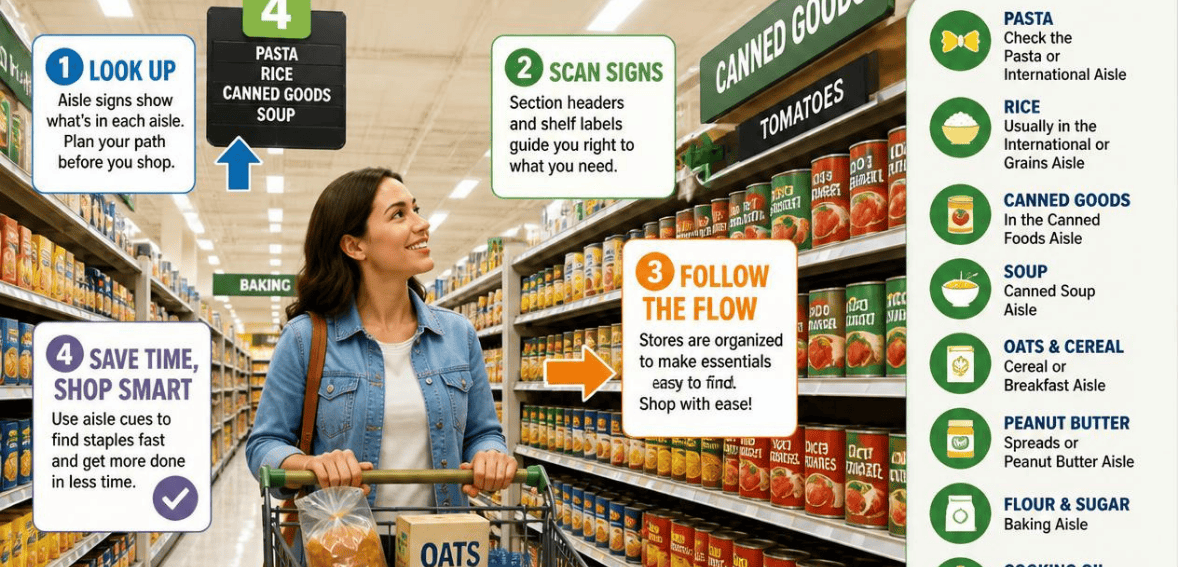
When it comes to aisle blade signs or shelf end panels, which are located at the aisle shelf ends, these signs assist the most with distance. Shoppers should be able to read these signs from at least 20 to 30 feet. Be straightforward with sign wording and avoid using unique brand names or be clever. Think of what shoppers are actually going to be searching for when they look at the sign. A sign for “Pasta” would be much better than an “Italian Pantry” sign, as that is likely what shoppers would be looking for.
Shelf-Edge Labels and Color Coding
Once a shopper reaches the shelf, labels close the loop. Clear price tags and product names confirm they found the right item. This last cue matters more than people think. It removes doubt and speeds up the decision.
Color coding is efficient. To take advantage of color coding, retailers can assign a tagging color to product-oriented assortments. They can use green tags to identify fresh and/or whole-food store staples. Customers intuitively learn the tagging codes, and through consistent use, the code becomes a store’s color map. For SNAP merchandising, there is a need for a simple visual system to identify eligible SNAP staple categories that can help to reduce frustration and searching for approved staple foods.
Digital Wayfinding and Interactive Displays
Newer tools take this further. Digital signage can act like a live map inside the store. Entryway kiosks show the full layout. Digital end caps mark categories while rotating in weekly deals. Some stores add interactive screens where a shopper types in an item and gets directions to the exact aisle.
These systems reduce aimless walking and also cut down on staff being interrupted to answer “where is the flour?”, etc.. You also don’t need to have a giant tech budget to reap the benefits either. Sometimes just having a store map at the entrance to help customers plan their route does the trick. If you want to understand the psychology behind these layouts and the way people are influenced to act, it is also worth checking out GoodRx’s explanations of grocery store layouts.
Closing the Merchandising Gap in Small Stores and Convenience Stores
Small format stores face the toughest version of this challenge. Space is tight. Every square foot has to earn its keep. Yet the same shoppers still need to find staples fast, and SNAP rules still apply.
The solution is discipline, not size. Group items so that related products are located together. Since shoppers think by meal, not by department, keep items such as pasta and sauce, or rice and beans, together. To aid your shoppers, use one sign above each section. With this layout, shoppers should be able to view the entire store in a matter of seconds. There should be at least one designated cold section containing perishables, which should be well stocked since a vacant section will be interpreted as “out of stock” items, even when they are not.
Having focused on the above, you will have a store that a first-time customer can navigate without the need for a staff member. You have adequately met the merchandising gap.
Example in Practice: The Look Company
The Look Company is a signage company that creates what it calls ‘journey-based’ signage. Signs are the result of three main principles: clarity, simplicity, and strategic placement. Grocery shoppers are typically busy, so signs should communicate instantly. Signs should be designed thinking of the overall wayfinding journey from the moment a shopper enters the store until they reach the checkout lane.
The journey-based approach is especially useful for grocery stores that are looking to improve the way shoppers locate essential items. In the company’s grocery store signage guide, you can find their ideas and the principles of journey signage in greater detail. The main idea for grocery signage is to think of your signage as a small customer service gesture.
Conclusion
Making staple foods easier to find is not a design luxury. It’s a core part of running a store that works for real people. Shoppers reward clarity with loyalty. They punish confusion by leaving.
Aisle cues are your simplest, cheapest tool. Overhead banners set direction. Aisle signs confirm the section. Shelf labels and color coding seal the choice. Digital wayfinding adds polish where the budget allows. Layer these cues, and you turn a frustrating hunt into a smooth trip.
For SNAP retailers, the stakes are even higher. With the updated stocking standards taking effect in November 2026, strong SNAP staple food merchandising protects your authorization and serves your community at once. Closing the merchandising gap means giving basics the space and signage they deserve. Do that, and your store becomes the place shoppers trust to have what they need, right where they expect it.
Frequently Asked Questions
What counts as a staple food for SNAP retailers?
Staple foods are basic items people cook and eat as a meal at home. The USDA sorts them into four categories: meat, poultry, or fish; breads or cereals; vegetables or fruits; and dairy. Snacks, candy, and hot prepared foods do not count. These are considered accessory or prepared foods.
What is the merchandising gap, and why does it matter?
The merchandising gap is the distance between what shoppers want and how stores are laid out. Many stores hide staples at the back or on hard-to-reach shelves to drive impulse buys. That frustrates shoppers looking for basics. Closing the gap with clear aisle cues keeps customers happy while still guiding them past discovery zones.
How do aisle cues make staple foods easier to find?
Aisle cues work in layers. Overhead banners signal broad categories from across the store. Aisle blade signs confirm sections from a distance. Shelf-edge labels and color coding remove doubt at arm’s reach. Together they create a mental map so shoppers locate staples without asking for help.
When do the new SNAP staple food stocking rules take effect?
The USDA published the final rule in May 2026, and SNAP-authorized retailers must comply by November 4, 2026. The update requires seven varieties in each of the four staple categories, at least three stocking units per variety, and one perishable option in three of the four categories.