By Caleb Castillo September 10, 2026
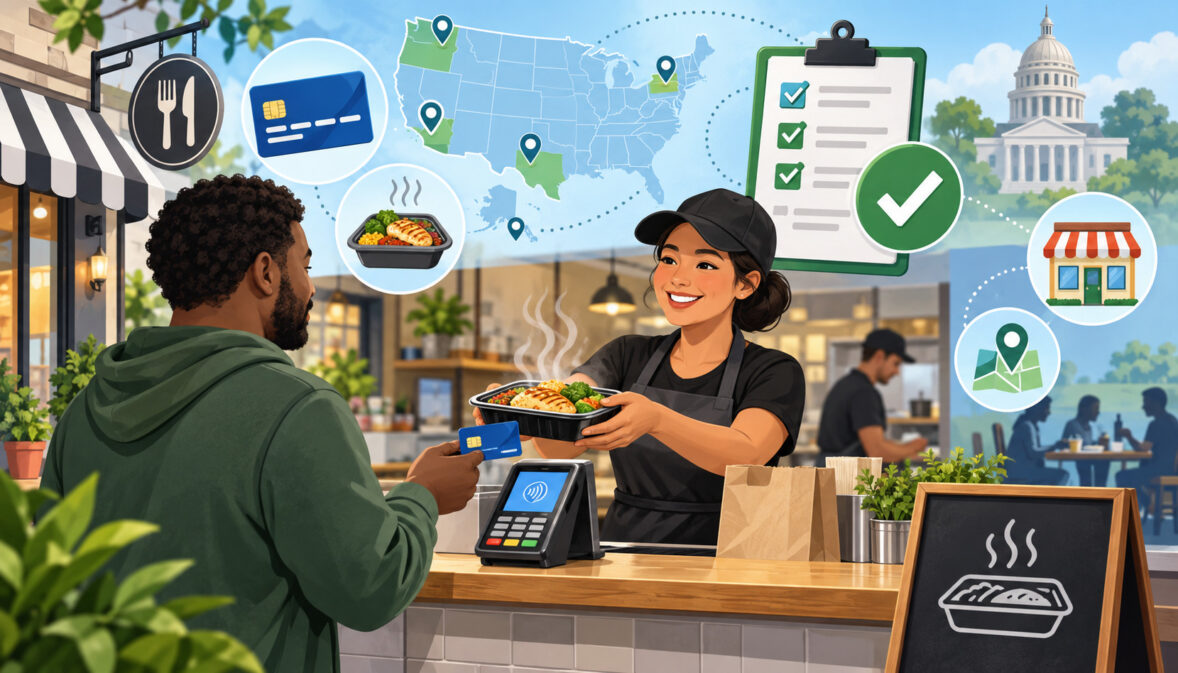
A restaurant cannot generally accept SNAP benefits for hot prepared meals simply because it has an EBT-capable terminal. Restaurant Meals Program EBT is a special SNAP pathway that allows approved restaurants in participating jurisdictions to sell prepared meals to certain SNAP households whose members may have difficulty storing or preparing food.
The Restaurant Meals Program, commonly called RMP, is optional for states. Where it operates, restaurant participation involves more than payment processing.
The business generally must qualify under the state’s RMP rules, complete the required state agreement or approval process, obtain USDA Food and Nutrition Service authorization, and then configure an approved EBT payment environment for restaurant transactions.
Not every SNAP household can use RMP. Eligibility is generally limited to qualifying elderly, disabled, or homeless households and eligible spouses under federal program rules. Restaurant employees do not determine those categories at the register.
The EBT system recognizes whether the SNAP account is authorized for restaurant-meal use and approves or declines the transaction accordingly.
As of September 10, 2026, USDA identifies Arizona, California, Illinois, Maryland, Massachusetts, Michigan, New York, Rhode Island, and Virginia as states operating the Restaurant Meals Program. Geographic scope, restaurant application availability, pricing requirements, and local implementation can still differ substantially from one state to another.
What Is the Restaurant Meals Program?
The Restaurant Meals Program is an optional part of SNAP that participating states can use to give certain qualifying households access to prepared meals from approved restaurants.
USDA explains that the program is intended for people who may have difficulty preparing meals for themselves or who may lack access to facilities where food can be stored and cooked.
Current federal eligibility categories include people age 60 or older, people meeting the applicable disability criteria, people experiencing homelessness, and spouses of otherwise qualifying RMP participants.
An important federal condition is that the household must meet the applicable RMP composition rules. A person does not automatically gain restaurant-meal purchasing rights merely because the household receives SNAP.
RMP therefore differs from ordinary SNAP food purchasing in two ways.
First, it expands where qualifying SNAP benefits can be used. Instead of being limited primarily to eligible food intended for household consumption, certain recipients can use SNAP benefits for qualifying prepared restaurant meals.
Second, it creates a separate participation pathway for restaurants. A restaurant does not become an approved SNAP restaurant merely by installing an EBT terminal or obtaining an ordinary merchant account.
The basic structure is:
State operates RMP → restaurant qualifies under state rules → restaurant completes required state agreement → USDA FNS authorizes the restaurant → processor enables RMP transactions → eligible SNAP household pays for a qualifying meal.
Each layer serves a different purpose. State agencies determine whether and how restaurants participate in the state program, USDA FNS controls federal SNAP retailer authorization, and the EBT payment system determines whether the particular account and transaction can be approved.
Why SNAP Normally Excludes Hot Restaurant Food

Ordinary SNAP rules are built primarily around groceries and other eligible food products intended for household consumption.
Under current USDA SNAP eligible-food guidance, SNAP benefits generally cannot be used for food that is hot at the point of sale. RMP creates a specific restaurant-meal exception for qualifying households in participating states rather than eliminating the ordinary hot-food restriction for all SNAP customers.
A conventional grocery store and an RMP restaurant therefore operate through different SNAP concepts.
A grocery store may qualify for SNAP authorization because it sells sufficient staple-food inventory or because staple foods make up the required share of its sales. A restaurant, by contrast, primarily sells food prepared for immediate consumption.
RMP creates the special restaurant pathway for participating jurisdictions and qualifying SNAP households.
| Business or Transaction | General SNAP Treatment | RMP Relevance |
| Grocery store selling qualifying food for home consumption | May qualify under ordinary SNAP retailer rules | RMP generally not needed |
| Cold qualifying food sold for household consumption | May be SNAP eligible | Does not automatically make the seller an RMP restaurant |
| Restaurant selling prepared meals | Generally outside ordinary SNAP restaurant use | RMP may provide a qualifying pathway |
| Hot prepared restaurant meal | Normally excluded under standard SNAP rules | Can qualify through RMP |
| Restaurant with an EBT-capable terminal only | Hardware does not establish eligibility | State and FNS approval are still required |
This distinction matters during the application process.
A restaurant should not assume that grocery-store stocking requirements or standard retailer qualification rules are automatically the correct path. Restaurants applying specifically for RMP generally use the federal meal-service authorization process connected to their state’s program.
Businesses that need a broader understanding of the underlying retailer framework can review SNAP retailer eligibility requirements to see how ordinary retail authorization differs from the restaurant-meal exception.
Which States Currently Operate RMP?
The RMP states list should always be checked against current USDA and official state information.
Programs change over time. States may expand from pilot programs, restrict participation geographically, temporarily close restaurant applications, or operate statewide while still having few approved restaurants in particular counties.
According to the current USDA list of states operating a Restaurant Meals Program, the participating states are Arizona, California, Illinois, Maryland, Massachusetts, Michigan, New York, Rhode Island, and Virginia as verified for this article on September 10, 2026.
- Arizona
- California
- Illinois
- Maryland
- Massachusetts
- Michigan
- New York
- Rhode Island
- Virginia
A state’s presence on the federal list does not necessarily mean restaurants can participate everywhere within the state or submit applications at any time.
Current RMP State Participation
Information verified as of September 10, 2026
| State | RMP Active? | Geographic Scope | Responsible Agency | Official Source |
| Arizona | Yes | State program with approved participating locations | Arizona Department of Economic Security | Arizona Restaurant Meals Program guidance |
| California | Yes | Statewide across all 58 counties; restaurant availability varies | California Department of Social Services | California CalFresh Restaurant Meals Program |
| Illinois | Yes | Cook and Franklin Counties under current USDA listing | Illinois Department of Human Services | USDA RMP state listing |
| Maryland | Yes | Participating jurisdictions; expansion may occur over time | Maryland Department of Human Services | Maryland Restaurant Meals Program |
| Massachusetts | Yes | Selected restaurants and food trucks; application availability varies | Department of Transitional Assistance | Massachusetts SNAP Restaurant Meals Program |
| Michigan | Yes | State program with approved locations in participating communities | Michigan Department of Health and Human Services | Michigan Restaurant Meal Program |
| New York | Yes | Statewide program; restaurant availability varies by area | Office of Temporary and Disability Assistance | New York Restaurant Meals Program |
| Rhode Island | Yes | Limited approved participating restaurant locations | Rhode Island Department of Human Services | Rhode Island Restaurant Meals Program |
| Virginia | Yes | State program with approved participating locations | Virginia Department of Social Services | Virginia Restaurant Meals Program |
California states that its RMP is administered statewide across all 58 counties. That does not mean every restaurant can join automatically or that participating restaurants exist in every neighborhood.
New York has also moved beyond its earlier pilot structure into statewide RMP operation. Restaurant availability still depends on which businesses have completed the approval process.
Illinois remains an important example of geographic limitation because current federal information identifies Cook and Franklin Counties rather than statewide restaurant participation.
County-Level and Local Variations
Restaurant operators should answer three separate questions before beginning an application:
- Does the state currently operate RMP?
- Is the restaurant’s specific location within the participating geographic area?
- Is the state currently accepting or selecting additional restaurants?
Those questions should not be treated as interchangeable.
A state may have an established Restaurant Meals Program while limiting the number or type of restaurants admitted. Another may operate in selected counties. A state with statewide recipient eligibility may still have participating restaurants concentrated in particular communities.
Massachusetts, for example, currently operates an RMP but has used a selective vendor process and may close application periods.
Maryland continues to operate through participating jurisdictions and may expand over time.
Illinois currently has a narrower geographic footprint.
These differences are why unofficial “restaurants that accept EBT” directories are not reliable sources for deciding whether a new restaurant can apply.
How to Verify Whether Your Restaurant’s County Participates
Use a verification process before paying for equipment or changing the POS:
- Check USDA’s current Restaurant Meals Program page.
- Confirm that the state appears among currently operating RMP states.
- Open the official state RMP page.
- Look specifically for restaurant, vendor, or business participation guidance.
- Confirm county, municipality, ZIP-code, or pilot restrictions.
- Determine whether restaurant applications are currently open.
- Review any state agreement, MOU, vendor criteria, or procurement requirements.
- Contact the state RMP office when local eligibility is unclear.
Avoid basing the decision on a consumer-facing restaurant directory. A directory may show where customers can currently eat, but it does not necessarily explain whether new businesses in the area can apply.
Who Can Use the Restaurant Meals Program EBT?

Not every SNAP customer can use benefits at a participating restaurant.
Federal RMP rules are designed around households whose members meet specific conditions related to age, disability, homelessness, or qualifying spousal status.
RMP Customer Eligibility
| Eligibility Category | Federal Condition | Restaurant’s Responsibility |
| Elderly | Generally age 60 or older | Submit the RMP transaction normally |
| Disabled | Must meet applicable federal disability eligibility criteria | Do not request medical records or disability proof |
| Homeless | Must meet the applicable SNAP definition of homelessness | Do not manually investigate housing status |
| Spouse | Spouse of an otherwise eligible RMP participant | Follow the EBT transaction result |
| Household not meeting RMP rules | Restaurant-meal eligibility does not apply | Do not override a decline |
Federal homelessness rules include people who lack a fixed and regular nighttime residence and certain people staying in shelters, qualifying temporary accommodations, institutions providing temporary residence, or places not ordinarily designed for sleeping.
Those definitions matter to state benefit agencies, but restaurant workers should not try to administer them.
The cashier’s responsibility is transaction handling, not SNAP eligibility adjudication.
How Customer Eligibility Is Recognized
The practical rule for restaurants is straightforward:
The restaurant submits the RMP transaction, and the EBT system determines whether that SNAP account is permitted to use benefits at a restaurant.
Eligible accounts are coded or designated through the state-administered benefit system. If the household is not eligible for restaurant-meal use, the RMP transaction should not approve.
Restaurant staff therefore should not ask customers to prove that they:
- are over a certain age beyond normal transaction procedures;
- receive disability benefits;
- have a particular medical condition;
- are homeless;
- live in a shelter; or
- belong to another qualifying category.
Employees should also never attempt to override an RMP eligibility decline.
If SNAP cannot approve the restaurant transaction, the customer may use another available form of payment.
How a Restaurant Gets Approved for RMP

SNAP hot food restaurant approval involves more than ordinary merchant onboarding.
USDA’s current framework requires a participating restaurant to be located in an RMP state, receive the applicable state approval, complete the required state agreement, and obtain FNS authorization before accepting SNAP restaurant payments.
State RMP Application
The state participation process determines whether the restaurant may join that state’s Restaurant Meals Program.
Requirements are not uniform.
Arizona uses a state Memorandum of Understanding process for interested restaurants.
Michigan directs restaurant operators through its RMP application materials and state participation agreement.
Maryland reviews a state RMP application package and coordinates the federal authorization step.
Virginia requires participating restaurants to execute a state agreement and follows a state-managed process for transmitting or coordinating federal application documents.
Massachusetts has used a more selective model in which restaurants and food trucks are evaluated against program criteria rather than simply being admitted automatically.
A state may consider factors such as:
- location;
- community need;
- restaurant format;
- business licensing;
- menu structure;
- affordability;
- accessibility;
- ability to serve the target population;
- ownership structure;
- compliance history; and
- willingness to meet state contract conditions.
The business should follow the requirements stated in its current state application rather than relying on another state’s checklist.
USDA FNS Restaurant Authorization
State approval alone is not enough.
The restaurant also needs USDA FNS authorization to accept SNAP through RMP.
The applicable federal form is Form FNS-252-2, SNAP Application for Meal Services. It is designed for qualifying meal-service establishments, including restaurants participating through the RMP framework.
This is one reason restaurants should not assume that a standard grocery-store SNAP application is the correct route.
The FNS restaurant application may require information about the business, ownership, location, state agreement, authorization contacts, and other information needed for USDA’s retailer review.
Restaurants that are unfamiliar with federal authorization concepts can review how FNS SNAP retailer authorization works while keeping in mind that an RMP restaurant follows the meal-service pathway rather than ordinary grocery qualification alone.
Which Approval Comes First?
The federal framework requires the state participation step to be established before the restaurant completes federal authorization as an RMP restaurant.
In practice, states administer the handoff differently.
Some states collect both state and federal documents together.
Some approve the restaurant first and then provide instructions for Form FNS-252-2.
Others review the full package and forward the federal portion to USDA.
The underlying sequence is still:
State RMP eligibility and agreement → federal FNS authorization → payment activation.
Approval Sequence
| Step | State Role | USDA FNS Role | Restaurant Action |
| Confirm program availability | Defines where RMP operates within the state | Maintains federal RMP framework | Verify state and location |
| Review restaurant eligibility | Applies state criteria | — | Confirm the business qualifies |
| Submit state documents | Reviews agreement/application | — | Complete state paperwork |
| Obtain state acceptance | Approves or selects restaurant | — | Secure state participation |
| Complete federal form | May collect or forward documents | Reviews FNS-252-2 | Provide required federal information |
| Receive federal authorization | May communicate or coordinate outcome | Determines SNAP authorization | Do not process until approved |
| Configure processing | May provide program instructions | Authorization must be active | Board restaurant with processor |
| Begin RMP transactions | Maintains state program requirements | Maintains federal retailer oversight | Follow operating controls |
Maryland and Virginia demonstrate why restaurants should read their state’s procedure carefully. Both use state involvement in coordinating federal authorization rather than directing restaurants to improvise the process independently.
Restaurant Eligibility Requirements
There is no universal checklist that guarantees a restaurant will qualify in every RMP state.
States may evaluate:
- type of restaurant;
- service model;
- restaurant location;
- business licenses;
- health permits;
- accessibility;
- menu offerings;
- meal pricing;
- ability to serve targeted SNAP households;
- good standing;
- ownership information;
- physical dining arrangements; and
- compliance with state and federal program conditions.
Michigan, for example, has published restaurant participation criteria involving low-cost meals, appropriate POS capability, disability accessibility, and legal compliance.
Massachusetts has permitted selected food trucks as well as restaurants but has used vendor-selection criteria and specific program conditions.
Maryland’s framework expressly accommodates certain qualifying mobile food operations under its state rules.
Because these models differ, a food truck that qualifies in one state should not assume identical eligibility elsewhere.
The same caution applies to ghost kitchens, delivery-only businesses, concessions, shared kitchens, and temporary food operations.
Franchise, Chain, and Multi-Location Restaurants
A chain restaurant should treat each location as a separate compliance question.
State participation may depend on the exact address, county, ownership arrangement, or restaurant format.
Virginia expressly requires each participating restaurant location to have its own agreement.
Other states may permit consolidated administrative handling of multiple sites while still requiring location-specific identification and authorization.
A franchisor’s national POS agreement does not replace state participation or federal SNAP authorization.
A franchisee should verify:
- whether its location falls within the state program;
- whether the state accepts franchise locations;
- whether a separate agreement is required;
- whether FNS authorization applies separately to the site;
- whether its current processor can board that specific location for RMP; and
- whether menu pricing satisfies program rules.
Restaurant groups planning broader benefit acceptance can use the same location-by-location control principles described for multi-location EBT operations.
Concessional Pricing Expectations
RMP’s federal statutory framework includes the concept of meals being provided at concessional prices.
That does not mean every state applies the same percentage discount or menu structure.
The exact requirement can come from federal law, state program design, or the agreement signed between the restaurant and the state.
Examples illustrate the variation.
New York currently states that eligible RMP participants receive a 10% discount at participating restaurants.
Massachusetts has required participating vendors to offer a reduced-price meal option.
Michigan describes participating restaurants as providing low-cost meals.
Maryland also addresses concessional pricing through its state RMP framework.
A restaurant should therefore determine:
- whether every qualifying meal must receive a discount;
- whether only designated RMP meals must be reduced;
- whether the state specifies a percentage;
- whether promotional pricing can satisfy the requirement;
- how menu changes affect the agreement; and
- whether the reduced price must be displayed in a particular manner.
Do not create a discount percentage based on another state’s policy.
What RMP POS Requirements Mean for Restaurants
RMP POS requirements go beyond whether a terminal can technically read an EBT card.
The restaurant needs an EBT-capable processing environment tied to the correct authorization and configured for restaurant-meal transactions.
A properly configured setup must allow the restaurant to:
- choose SNAP EBT as the appropriate tender;
- submit the approved transaction through EBT routing;
- allow secure PIN entry;
- recognize the restaurant’s authorized merchant setup;
- respect the account’s RMP eligibility result;
- separate SNAP-eligible amounts from excluded charges;
- support split tender when needed;
- generate appropriate receipts; and
- reconcile RMP activity.
Restaurants comparing equipment should focus on actual workflow rather than hardware labels. A terminal described as “EBT compatible” may still require authorization, processor boarding, software configuration, and RMP-specific activation.
For restaurants deciding how tightly benefit processing should connect to their checkout system, this EBT POS setup guide explains the operational difference between integrated and separate payment workflows.
RMP-Coded Transactions
At a high level, the payment system needs to recognize both the merchant’s RMP authorization and the customer’s restaurant-meal eligibility.
The restaurant does not need to see or understand the underlying benefit-system coding.
The useful operating rule is:
Select the authorized EBT tender, submit the correct eligible amount, allow the customer to authenticate the transaction, and follow the approval or decline returned by the system.
No employee should attempt to alter account eligibility.
PIN Entry
SNAP EBT transactions generally require the cardholder to enter a personal identification number.
The restaurant should use equipment that permits the customer to enter the PIN securely.
Employees should never ask a customer to disclose the PIN verbally or write it down.
PIN privacy is especially important in full-service environments, where staff may otherwise be accustomed to carrying payment cards away from the table. RMP workflows should be designed so the customer can personally complete required authentication.
Integrated POS vs. Standalone EBT Terminal
Restaurants generally encounter two practical processing models.
| Feature | Integrated POS | Standalone EBT Terminal |
| Tender selection | Usually handled through normal POS screen | Entered on separate terminal |
| Eligible amount | Can potentially flow from POS | Often entered manually |
| Split tender | Can be easier to coordinate | Usually requires separate steps |
| Reporting | May appear in unified reports | Often reconciled separately |
| Installation | More system integration may be required | Often easier to retrofit |
| Manual-entry exposure | Potentially lower | Potentially higher |
| Best fit | Restaurants prioritizing centralized checkout | Restaurants needing a simpler separate EBT device |
An integrated system may simplify amount transfer and reconciliation, but only when the integration actually supports SNAP and RMP correctly.
A standalone terminal can be practical for a restaurant that does not want to replace its main POS. The tradeoff is that staff may need to enter the eligible amount manually and reconcile EBT settlements separately.
Businesses comparing devices should verify actual benefit functionality rather than buying equipment solely because it is advertised as an EBT-compatible payment terminal.
Menu, Pricing, Tax, and Tip Rules
RMP expands SNAP purchasing rights for qualifying prepared meals, but it does not turn the SNAP account into a general restaurant payment account.
The restaurant must distinguish the meal itself from charges that SNAP cannot fund.
What SNAP Can and Cannot Pay
| Charge Type | SNAP/RMP Treatment | POS Control |
| Qualifying RMP meal | May be paid with SNAP when customer and restaurant are eligible | Submit eligible amount |
| Alcohol | Not SNAP eligible | Exclude from SNAP tender |
| Tobacco or nicotine merchandise | Not SNAP eligible | Use another tender |
| Nonfood merchandise | Generally not SNAP eligible | Separate from SNAP amount |
| Sales/meals tax on SNAP purchase | Should not be charged against SNAP-funded portion | Configure tax exemption correctly |
| Voluntary tip | Cannot be funded with SNAP | Use another tender |
| General service or processing fee | Generally cannot be paid from SNAP | Keep outside eligible total |
| Other excluded restaurant charge | Depends on federal/state treatment | Map to non-SNAP tender |
Sales Tax
USDA rules generally prohibit charging state or local sales tax on purchases made with SNAP benefits.
For RMP restaurants, state guidance reinforces this treatment.
Maryland prohibits sales or meals tax on RMP meals.
Massachusetts describes participating RMP meals as exempt from meals tax.
Virginia likewise states that sales tax is not charged on meals purchased through RMP using SNAP.
The practical POS problem occurs when the register calculates tax before the customer chooses the tender.
If a meal is paid partly with SNAP and partly with another tender, the software must apply the applicable tax rules correctly to each portion rather than simply taxing the original check indiscriminately.
Restaurants should test this before launch.
Tips and Gratuities
SNAP benefits should not be used to pay voluntary restaurant tips.
Massachusetts expressly tells participants that SNAP cannot be used to leave a tip.
Maryland also prohibits participating restaurants from charging or collecting a service gratuity on meals sold through the program.
A restaurant whose POS automatically calculates an 18%, 20%, or other suggested tip should make sure that amount is not added to the SNAP tender request.
Mandatory service charges require careful review as well. Federal SNAP rules generally prevent benefit funds from being used for ordinary service, delivery, processing, and similar fees unless a specific exception applies.
A restaurant should therefore examine the state agreement and processor configuration before treating any mandatory fee as SNAP eligible.
Split Tender and Non-SNAP Charges
Split tender becomes important when part of the check qualifies for SNAP and part does not.
Consider an illustrative transaction:
RMP-eligible meal: $18
Charge that cannot be paid with SNAP: $3
Total customer obligation: $21
A compliant payment structure might be:
SNAP EBT: $18
Cash, debit, credit, or another permitted tender: $3
The restaurant should not push the full $21 through SNAP merely because the customer has sufficient SNAP balance.
Split tender may also be needed when the qualifying meal costs more than the customer’s remaining SNAP balance.
For example:
Eligible meal: $20
Available SNAP balance applied: $13
Remaining balance: $7
The customer can use another acceptable tender for the remaining amount when the state and POS process support mixed payment.
The key control is that the SNAP transaction should never exceed the amount that may actually be funded with SNAP.
Restaurant-Specific RMP Compliance Risks
Restaurant authorization creates ongoing responsibilities.
Errors can occur because employees treat SNAP like an ordinary card tender even though it carries program restrictions.
Restaurant Compliance Risks
| Issue | Why It Creates Risk | Correct Control |
| Processing every SNAP card as RMP eligible | Not every SNAP household qualifies | Rely on EBT authorization |
| Overriding a declined transaction | Circumvents eligibility controls | Use another payment method |
| Including alcohol | Alcohol cannot be bought with SNAP | Exclude from benefit tender |
| Charging tax to SNAP | SNAP-funded purchases generally cannot bear sales tax | Configure tax logic |
| Including a tip | SNAP cannot pay voluntary gratuity | Separate payment |
| Adding prohibited fees | Benefits cannot be used for ordinary nonfood charges | Keep outside SNAP amount |
| Cash refund for SNAP sale | Improperly converts benefits to cash | Return value to EBT account |
| Fictitious meal sale | Can constitute trafficking | Process legitimate purchases only |
| Weak employee training | Creates repeatable operating errors | Maintain written procedures |
| Using approval from another site | Authorization may be location-specific | Verify each location separately |
Restaurants can reduce routine errors by maintaining the same types of controls used in broader SNAP transaction compliance procedures, while adding the restaurant-specific RMP restrictions discussed here.
Noneligible Customers and Transactions
The customer’s RMP status belongs to the benefit system.
A compliant restaurant workflow is:
- Enter or calculate the permitted SNAP amount.
- Select the approved SNAP EBT tender.
- Allow the customer to enter the PIN.
- Follow the authorization result.
- If declined, do not bypass the result.
- Offer another payment method where appropriate.
A server should not attempt to rerun the transaction as an ordinary grocery SNAP purchase simply because the RMP transaction was denied.
The restaurant’s authorization does not change the customer’s eligibility.
Noneligible Items or Charges
Mixed restaurant checks can contain many charges that require separation.
Common examples include:
- alcoholic beverages;
- merchandise;
- catering or delivery fees;
- gratuities;
- service fees;
- sales tax;
- promotional merchandise;
- gift cards; and
- other nonfood charges.
The POS should make it difficult for employees to accidentally include these categories in a SNAP total.
Where item-level programming is available, the system may separate them automatically.
Where the restaurant uses a standalone EBT terminal, employees may need to enter the eligible total manually. That makes written procedures and manager review particularly important.
Trafficking and Cash Exchange
SNAP trafficking includes exchanging SNAP benefits for cash rather than legitimate qualifying food.
For a restaurant, this means there must be a real eligible transaction behind the SNAP payment.
Examples of prohibited conduct include fictitious restaurant sales used solely to extract benefit value or providing cash instead of the qualifying meal.
The purpose of compliance controls is prevention, not determining how much unusual activity might escape review.
How FNS Detects and Investigates Violations
FNS monitors retailer transaction activity for program-integrity concerns.
Publicly described enforcement sources can include:
- electronic transaction information;
- suspicious activity analysis;
- customer complaints;
- referrals;
- retailer investigations;
- records review; and
- information obtained during administrative proceedings.
Restaurants should not interpret these mechanisms as thresholds to work around.
An unusual transaction is not automatically a violation, and a small transaction is not automatically permissible. The underlying issue is whether SNAP was used according to program rules.
FNS Investigations and Sanctions
When suspected violations arise, FNS may review retailer activity and pursue administrative enforcement under SNAP regulations.
Depending on the nature and seriousness of the conduct, consequences may include:
- administrative warning or corrective action where applicable;
- temporary disqualification;
- permanent disqualification for qualifying severe violations;
- civil money penalties where federal law authorizes them;
- other administrative remedies; or
- additional legal consequences in appropriate cases.
Penalty amounts and sanction periods should not be generalized because they depend on the regulatory provision and facts involved.
Refunds, Voids, and Reversals
Restaurant staff should not handle SNAP refunds the same way they might handle a cash sale.
When a purchase originally paid with SNAP must be refunded, the benefit value generally needs to be returned electronically to the customer’s SNAP EBT account through the authorized procedure.
The restaurant should not give cash in place of SNAP benefits.
That rule is important because cash refunds can improperly convert benefits into cash.
Restaurants should document separate processor procedures for:
- refunds;
- transaction voids;
- reversals;
- duplicate transactions;
- declined transactions; and
- interrupted EBT transactions.
A void usually cancels a transaction before final settlement or through a processor-supported transaction function.
A reversal generally addresses a transaction that needs to be unwound because of an authorization or communications issue.
Exact functionality varies by EBT processor and terminal.
Employees should use approved processor functions rather than inventing manual corrections.
EBT Receipts and Customer Information
RMP transactions should produce receipts that meet applicable EBT requirements without exposing protected card information.
Federal EBT receipt requirements generally include transaction information such as:
- store name and location;
- transaction type;
- transaction amount;
- date;
- appropriate remaining balance information; and
- an abbreviated card number.
The full EBT card number should not be printed.
Restaurant receipts may also contain meal details and other tender information, but the POS should avoid unnecessarily exposing customer benefit data.
Receipt testing should be included in launch preparation.
How to Train Staff and Reconcile RMP Sales
Staff training is one of the most important operational controls because servers and cashiers interact directly with RMP transactions.
Training should explain:
- how to select SNAP EBT;
- how to identify the amount being submitted to SNAP;
- that the EBT system determines customer RMP eligibility;
- that employees should not ask for disability or homelessness documentation;
- that customers enter their own PIN;
- how to handle a decline;
- how split tender works;
- how taxes are treated;
- how tips are treated;
- which other charges must remain outside SNAP;
- how to process refunds correctly;
- what receipt information is required;
- when to call a manager; and
- how to report a suspected POS configuration problem.
The training does not have to be complicated.
A one-page cashier workflow combined with manager instruction is often more useful than a lengthy policy that employees never consult.
Recommended Reconciliation Structure
Separate restaurant payment reporting into categories such as:
- RMP SNAP sales;
- ordinary cash;
- credit cards;
- debit cards;
- other EBT transactions where applicable;
- split-tender sales;
- refunds;
- reversals;
- voids; and
- settlement adjustments.
Location-level reporting is especially useful for multi-unit operators.
If one restaurant suddenly shows unusually high EBT refunds or repeated manual adjustments, management can identify the issue quickly instead of discovering it during a later program review.
Changes in Ownership and New Restaurant Locations
RMP approval should not be assumed to transfer automatically when a restaurant is sold or when ownership changes.
Federal SNAP authorization is generally tied to the authorized firm and location and is not freely transferable to a purchaser.
States may also require new applications or agreements when ownership changes.
Virginia specifically states that RMP authorization cannot simply transfer to a new owner.
A restaurant sale should therefore trigger a review of:
- state RMP participation;
- current ownership information;
- federal FNS authorization;
- processor boarding;
- bank settlement information;
- POS configuration; and
- signage or other program materials.
The same principle applies to new locations.
New Location Checklist
Before adding RMP to another restaurant site:
- confirm the state still operates RMP;
- confirm the new site’s county or jurisdiction participates;
- determine whether applications are open;
- review state eligibility requirements;
- complete the required state agreement;
- obtain location-specific FNS authorization where required;
- configure the correct merchant location with the EBT processor;
- test tax and split-tender treatment;
- train staff; and
- reconcile the site independently.
Approval at Restaurant A should never be treated as automatic authority for Restaurant B.
Common RMP Application and Setup Mistakes
The most common problems are usually misunderstandings about authorization rather than complex payment failures.
| Mistake | Why It Creates Risk | Better Approach |
| Assuming ordinary EBT retailer approval is enough | RMP requires a restaurant-specific participation pathway | Confirm state RMP and FNS meal-service authorization |
| Using an old RMP states list | Program availability changes | Verify USDA and state information immediately before applying |
| Assuming every county participates | Some programs remain geographically limited | Confirm the restaurant’s exact location |
| Assuming every SNAP customer qualifies | RMP household eligibility is separate | Follow EBT approval or decline |
| Buying equipment before verifying eligibility | Terminal may never be usable for RMP | Confirm authorization path first |
| Completing only the state application | Federal authorization may still be missing | Complete the required FNS process |
| Treating any EBT terminal as RMP-ready | Proper merchant setup and routing are required | Confirm restaurant boarding with processor |
| Allowing SNAP to pay tips or excluded charges | Violates benefit restrictions | Configure tender exclusions |
| Manually overriding a decline | Circumvents eligibility controls | Offer another tender |
| Giving cash refunds | SNAP value should return to the EBT account | Use approved refund procedure |
| Failing to train servers | Creates inconsistent checkout practices | Use written procedures and manager escalation |
Practical RMP Restaurant Approval Workflow
Restaurant operators can use the following sequence as a working framework while adapting it to the specific state process.
- Confirm the state currently operates RMP.
Use USDA’s current RMP resources rather than an old third-party state list. - Confirm the restaurant’s location is eligible.
Check county, municipality, or pilot limitations. - Determine whether applications are open.
A functioning state program does not necessarily accept new restaurants continuously. - Review restaurant eligibility requirements.
Check restaurant type, licensing, accessibility, service format, menu, and other conditions. - Review pricing requirements.
Identify any concessional or reduced-price meal obligation. - Complete the state application or agreement.
Follow the exact state submission instructions. - Obtain state approval or referral.
- Complete the required FNS restaurant application.
Use Form FNS-252-2 or the current state-coordinated process. - Receive federal FNS authorization.
- Choose an EBT processor that supports authorized RMP restaurants.
- Configure the terminal or integrated POS.
- Configure tax treatment.
- Exclude gratuities and other prohibited charges from SNAP tender.
- Configure split tender where needed.
- Confirm secure customer PIN entry.
- Test the approved workflow with the processor or state-authorized method.
- Train cashiers, servers, supervisors, and managers.
- Begin live acceptance only after authorization and activation are complete.
- Reconcile RMP activity separately.
- Maintain authorization and compliance records.
- Recheck program requirements before ownership, location, menu, or POS changes.
Restaurant Meals Program EBT Approval Checklist
- Confirm the state currently operates RMP.
- Confirm the restaurant’s exact location is eligible.
- Verify whether restaurant applications are open.
- Review current state participation criteria.
- Confirm required business and restaurant licensing.
- Review concessional-pricing requirements.
- Review menu conditions.
- Complete the state RMP agreement or application.
- Obtain state acceptance.
- Complete the required USDA FNS restaurant authorization.
- Save the authorization records.
- Confirm the processor can enable RMP at the approved location.
- Configure the POS or terminal.
- Confirm customer PIN entry works securely.
- Configure split tender.
- Configure tax treatment.
- Keep tips outside SNAP tender.
- Keep alcohol and other excluded charges outside SNAP tender.
- Confirm refund procedures return SNAP value electronically.
- Review receipt configuration.
- Train cashiers and servers.
- Tell employees not to manually determine customer RMP eligibility.
- Tell employees never to override an RMP eligibility decline.
- Reconcile RMP transactions separately.
- Maintain program agreements and POS documentation.
- Recheck requirements before adding another restaurant location.
Frequently Asked Questions
What is the Restaurant Meals Program?
The Restaurant Meals Program is an optional SNAP program that allows qualifying SNAP households to purchase prepared meals from approved restaurants in participating states. It primarily serves eligible elderly, disabled, and homeless households and qualifying spouses.
Can any restaurant accept SNAP EBT?
No. A restaurant does not gain authority to accept SNAP for hot prepared meals simply by installing an EBT terminal. It generally needs state RMP participation approval and USDA FNS authorization.
Which states currently have the Restaurant Meals Program?
As of September 10, 2026, USDA lists Arizona, California, Illinois, Maryland, Massachusetts, Michigan, New York, Rhode Island, and Virginia as operating RMP.
Is RMP available statewide in every participating state?
No. Geographic implementation varies. Illinois, for example, remains limited to Cook and Franklin Counties under USDA’s current listing. Other states may operate statewide while having participating restaurants only in selected communities.
Who qualifies to use Restaurant Meals Program EBT?
Qualifying households generally consist entirely of members who meet RMP conditions involving age, qualifying disability, homelessness, or eligible spousal status under federal rules.
Can every SNAP recipient buy hot food at an RMP restaurant?
No. Ordinary SNAP eligibility does not automatically create RMP eligibility. The customer’s SNAP account must be eligible for restaurant-meal transactions.
How does the restaurant know whether the customer qualifies?
The restaurant does not manually decide. The customer’s EBT account is designated through the state benefit system, and the restaurant follows the approval or decline returned electronically.
Should employees ask for proof of disability or homelessness?
No. Restaurant staff should not attempt to independently verify those benefit eligibility conditions at the counter. They should process the authorized EBT transaction and follow the system response.
How does a restaurant apply for RMP?
Start with the official state RMP program. The restaurant generally completes the required state agreement or application and then proceeds through the USDA FNS meal-service authorization process in the sequence established by that state.
Do I apply to the state or USDA first?
The state participation step generally comes first or is coordinated with the federal paperwork. Some states collect and forward federal documents themselves. Follow the current instructions issued by the state RMP agency.
Does an RMP restaurant need USDA FNS authorization?
Yes. State participation alone does not replace federal SNAP authorization. RMP restaurants use the FNS meal-services authorization pathway.
What equipment is required?
The restaurant needs an EBT-capable POS or terminal that can be activated for the restaurant’s authorized RMP location and supports secure customer PIN entry. Hardware capability by itself is not sufficient.
Can SNAP pay sales tax on an RMP meal?
SNAP-funded purchases generally cannot be charged state or local sales tax. The POS should apply the correct tax treatment to the SNAP-funded portion of the restaurant transaction.
Can SNAP pay restaurant tips?
Voluntary tips cannot be funded with SNAP. Restaurants should keep the gratuity outside the SNAP tender amount.
Conclusion
Ordinary SNAP rules generally do not allow a restaurant to accept benefits for hot prepared meals. The Restaurant Meals Program is the specific exception for approved restaurants and qualifying SNAP households in participating states and jurisdictions.
For the restaurant, successful participation depends on following the authorization sequence rather than starting with payment hardware. Confirm current state and local RMP availability, satisfy the state’s participation requirements, complete the required USDA FNS authorization, and then configure the restaurant’s EBT processing environment.
Customer eligibility should be determined through the EBT system rather than by cashiers or servers. The POS must also keep prohibited charges outside the SNAP-funded amount, handle taxes correctly, support split tender where needed, protect PIN entry, and return refunds through approved EBT procedures.
The requirements should be reviewed again whenever the restaurant adds a location, changes ownership, alters its menu or pricing approach, or replaces its payment system. Consistent staff training and location-level reconciliation help preserve both accurate customer service and ongoing SNAP authorization.