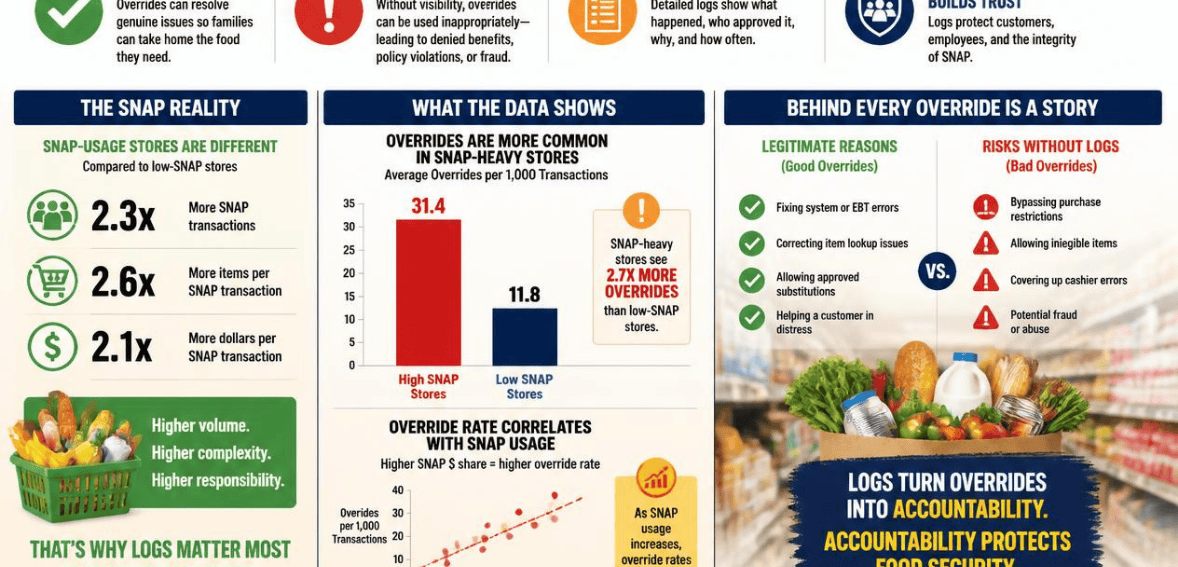
Picture a busy Friday afternoon. The line runs three deep. A cashier scans a case of soda on an EBT sale, and the register throws a block. Instead of stopping, someone taps in a manager code and pushes the sale through. Nobody writes it down. Nobody remembers it a week later.
USDA investigators search for that one undocumented moment. In a store where a significant portion of your daily sales is made up of SNAP transactions, it can even cost you your store’s authorization to participate in SNAP.
SNAP override logs should be prioritized in your compliance strategy. They aren’t just extra work for you. They are an internal control that protects your license, your sales, and your store’s reputation in front of the government. We will explain the SNAP override logs and their importance to stores with a large volume of SNAP transactions, as well as how to make a system you can defend.
What Are SNAP Override Logs?

A manager override log is a record of every time a staff member bypasses a normal control at the point of sale.
Most modern POS systems prevent certain actions by employees. For example, employees cannot void completed sales, delete items from sales, or force SNAP payments on restricted items. Each of those actions requires manager credentials for the POS.
SNAP override logs record each of those actions. A quality log will capture who approved the override, what action was taken, the time of the action, the register used, and the transaction ID. When you have enough of those logs, you have an audit trail. That audit trail provides a detailed account of how your store processed its most sensitive transactions.
The key word here is documented. An override that happens but leaves no record is invisible. An override that is logged is defensible.
Why Override Logs Matter More in SNAP-Heavy Stores
Every retailer benefits from clean records. But SNAP-heavy stores carry extra weight, and the reason comes down to who is watching.
SNAP is America’s largest food assistance program, serving 42 million people monthly at about a cost of $100 billion a year to taxpayers. With this much tax dollar assistance, program oversight is rigorous. The USDA’s Food and Nutrition Service, which became the Food and Nutrition Administration (FNA) in June 2026, is responsible for the authorization and oversight of the more than 260,000 SNAP retailers in the country.
This is what many store owners don’t seem to understand. Transactional data is collected and analyzed for possible abuse of the SNAP program each time a SNAP EBT card is swiped at a store. An automated system is used by the FNA to identify stores with SNAP program abuse anomalies. Unusual spikes in SNAP program redemptions, sales of whole dollar amounts, and unusually rapid transactions are all cause for scrutiny.
When your store is identified and flagged, a charge letter is issued to you. Over 2,000 charge letters are issued to small grocery and convenience stores each year by the FNA. Charge letters are typically time-sensitive, with a window of ten days to respond. During this ten-day window, the only protection you have from permanent disqualification is your ability to provide the required documentation.
As an unfortunate reality, you are wholly and legally responsible for SNAP program compliance for everything that occurs within your store as a SNAP retailer, including the activities of all store employees, even family members who are store volunteers. The agency will consider your store to be in violation of the SNAP program should benefit trafficking be conducted by an employee/cashier. The agency will consider the store’s policy and compliance to be evidenced by the violation logs and training records.
How Override Logs Strengthen Internal Controls

Every successful business uses internal controls to protect against costly errors and regulatory issues. Override logs are just one example of the internal controls that protect against fraud.
Many business owners underestimate the impact of internal theft. Some estimates suggest that, in the retail business, internal theft exceeds the losses caused by shoplifting. Internal theft is usually not very conspicuous. It can be caused by normal business activities, such as refunds, voids, price adjustments, and cash drawer openings with no sale. Theft can easily be integrated into the normal activities of a business when there are no controls to limit the actions of the employees.
Override logs break that pattern in two ways.
Role-Based Permissions
The first layer is permission. A well-configured POS assigns access by role. Cashiers get the tools they need to ring up sales and nothing more. High-risk actions get locked behind a manager credential.
That small pause changes behavior. A casual “fix” becomes a deliberate decision that requires a second person. Collusion gets harder because two people now have to agree to break a rule. Routine sales still move fast, but risky actions leave a fingerprint. The rule sets the tone, which is fairer to honest staff than vague warnings ever could be.
The Audit Trail
The record is the second layer. A reliable system records every override along with a date, time, and transaction ID, as well as the employee’s name. That two-way evidence is priceless during any inquiry.
For example, suppose one employee is canceling sales more than normal. In a store with no logs, that behavior goes unrecognized until the store starts losing money. In a store with SNAP override logs, you would see the report this week and you would take action to address the problem before it escalates. You are reading the logs and not taking a memory recall exam.
One more thing: a bypass as a result of a poorly designed control is a deficiency. A control that is working and is deliberately bypassed is an override. Both expose the system, but an override carries higher fraud risk because it involves a person deliberately stepping around a control that was working. Logs are used to distinguish the two and to support the claim.
Override Logs and FNA Compliance Reviews
When a compliance review lands, memory does not count. Documentation does.
Authorized SNAP retailers must keep their sales records for at least three years. Those records can be requested during a review or an investigation, and your POS should generate transaction-level reports that clearly separate EBT sales from cash, debit, and credit. Override logs are part of that same evidence package.
Let’s say an analyst is reviewing an unusual set of transactions. Having detailed logs can add transparency. Perhaps a supervisor fixed a price that was scanned wrong. Maybe one of the transactions was a split-tender transaction, and part of the transaction was SNAP-eligible and part was not. Having overrides along with proper documentation and time-stamps will help clarify what initially may appear to be a data anomaly.
Having no logs will put you at a disadvantage. Lack of documentation will hurt you the most, because in an administrative process, the burden is often on the retailer.
On the penalty side, having good logs, along with training documentation, can help shift the outcome from permanent disqualification from the program to a civil monetary penalty, which allows the retailer to continue participating in the program.
Common Overrides That Belong in Every Log

Not every keystroke needs a manager. But a handful of actions carry enough risk that they should always require approval and always leave a record.
Post-sale voids and refunds are the most concerning, for obvious reasons. However, they become more concerning the more cash is in the drawer, since they actually remove money from the register after a sale. Similar to price modifications, tax adjustments can shift and even alter the sale value and the items that were sold. Deleting a transaction line before payment can modify the transaction. SNAP is particularly susceptible to violations, as bypassing the payment block on a restricted item can convert an unqualified sale to a compliance violation. Therefore, all of the previously mentioned actions should be accompanied by a manager override and a log entry.
Choosing a POS That Handles SNAP Override Logs Well
Your logs can only be as good as your point-of-sale platform. Some systems attach EBT processing to a basic register and rely on a third-party terminal. Many of these systems do not itemize transactions in a way that the agency will accept, and owners usually only notice this when a review request comes in and the required records no longer exist.
A system that is specifically designed for handling EBT processes will provide you with all the functions you will need in terms of item-level eligibility, split tenders, permissions, and override logging in one integrated system that will help you comply with your obligations.
NRS (National Retail Solutions)
One example of a direct SNAP POS provider is NRS for independent grocers, bodegas, and convenience stores. NRS’s platform has EBT acceptance along with permission settings, hard block restrictions, and audit trails. With NRS’s platform, stores can facilitate EBT POS transactions and maintain compliance within SNAP. Compliance within SNAP can provide stores with significant margin relief, so having the NRS system can ease the worry of compliance.
Whatever platform you choose, the test is simple. Can it lock high-risk actions behind a manager credential, and can it hand you a clean, timestamped override report on demand? If the answer to either is no, your internal controls have a hole in them.
Building an Override Log Policy That Works
Technology is only half the job. A policy makes the logs meaningful.
Start by defining which actions require an override and putting it in writing. Train every employee on that policy within their first days on the job, then refresh it annually, and keep dated proof of that training. This matters enormously, because documented training is often what separates a fined store from a disqualified one.
Then, establish a regular override report review schedule rather than reviewing them in response to an issue. An early-stage review will reveal small, emerging issues. If you review and find an anomaly, record what you found, and close it. Over time, consistent report reviewing builds a documented pattern and leaves a record.
Finally, ensure the system’s integrity. No one, including the owner, should be able to modify or delete a log. The goal is to prevent anyone from quietly rewriting a record. For the record-keeping expectations, see the federal SNAP regulations at 7 CFR Part 278, and for background on the integrity landscape, see the Congressional Research Service overview of SNAP errors and fraud.
Conclusion
In a SNAP-heavy store, the checkout counter is a compliance frontier. Every void, refund, and forced payment is a small decision that a federal agency may one day ask you to explain.
SNAP override logs turn those decisions into evidence. They deter internal theft, they strengthen your internal controls, and they give you a clear, defensible answer when a charge letter arrives with a ten-day clock ticking. Pair a capable POS with a written policy, real training, and regular review, and you shift from hoping you can prove your case to knowing you can.
The stores that treat override logs as a core control, not an afterthought, are the ones that keep their authorization, protect their margins, and sleep at night. That is a trade worth making.
Frequently Asked Questions
What is a SNAP override log?
It is a record of every time an employee bypasses a normal point-of-sale control on a SNAP-related transaction. A complete entry shows who approved the override, what action was taken, the time, the register, and the transaction ID. Together, these entries form an audit trail you can produce during a compliance review.
How long do SNAP retailers have to keep override logs and sales records?
Authorized retailers must keep sales records for at least three years. These records can be requested during a compliance review or investigation, so keeping your override logs for the same period is a smart, defensible practice.
Can good override logs really prevent SNAP disqualification?
They can improve your odds significantly. If a violation traces back to one employee, proof of proper training combined with clean internal controls can move your case from permanent disqualification toward a civil monetary penalty, which lets the store keep accepting benefits. Logs alone are not a guarantee, but they are strong evidence in your favor.
Which POS actions should always require a manager override?
Post-sale voids, refunds, price and tax edits, line deletes, and any attempt to force a payment through a blocked or ineligible item. These are the highest-risk actions in a SNAP-heavy store, so each one should require a manager credential and leave a logged entry.