By Caleb Castillo September 10, 2026
Accepting SNAP EBT is only the starting point for a retailer that wants to participate in a produce incentive program. A Double Up Food Bucks retailer setup normally requires a second, separate relationship with the organization administering the incentive in the store’s state or community.
The basic sequence is:
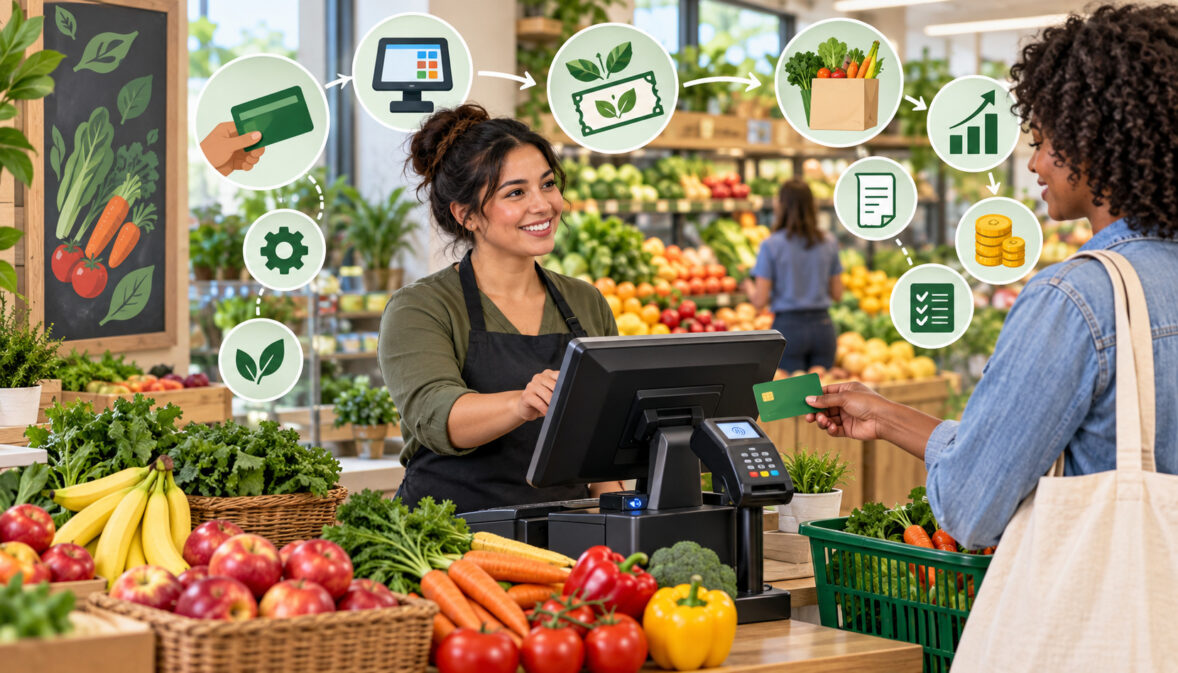
SNAP-authorized store → local incentive operator → retailer approval/agreement → eligible-product configuration → incentive issuance → incentive redemption → transaction tracking → reporting/reimbursement.
That distinction matters because there is no single national Double Up checkout specification. USDA’s Gus Schumacher Nutrition Incentive Program, or GusNIP, provides a federal funding and evaluation framework for projects that increase fruit and vegetable purchases by SNAP participants, but government agencies and nonprofit organizations receive and implement those awards through individual projects.
The local operator determines how participating retailers enroll and how the incentive functions at checkout. A Michigan grocery store, for example, may operate Double Up through coupons, a loyalty account, or the Double Up card and submit program sales for reimbursement.
Massachusetts’ Healthy Incentives Program works differently: participating farm vendors and their processing terminals must be enabled by the state, and qualifying HIP amounts can be applied through the EBT transaction itself.
For retailers, the practical question is therefore not merely, “Does my POS accept EBT?” It is, “Can my store participate in the specific incentive operating here, and can our register, reporting system, and staff execute that program’s rules accurately?”
How Double Up Food Bucks and GusNIP Incentives Work
Double Up Food Bucks is one example of a SNAP nutrition incentive program. The brand originated with Fair Food Network and is now represented in numerous states, but Double Up itself emphasizes that availability and program details differ geographically.
Its national locator currently identifies Double Up programs in more than 25 states while also pointing users in other states toward differently named nutrition incentive programs.
The useful framework for a retailer is to separate three layers.
| Layer | Organization | Responsibility |
| Federal funding/policy layer | USDA NIFA and SNAP/FNS | Funds eligible GusNIP projects, establishes applicable federal SNAP rules, and authorizes SNAP retailers |
| Program-operator layer | State agency, nonprofit, university, coalition, grantee, or program partner | Designs and administers the specific incentive, recruits retailers, defines implementation rules, provides training, collects data, and manages program funds |
| Retailer layer | Grocery, market, farm stand, mobile market, co-op, or other approved outlet | Executes the incentive at checkout, follows product and customer rules, trains staff, records transactions, and provides required reports |
The current Gus Schumacher Nutrition Incentive Program overview identifies GusNIP as a group of competitive programs that includes the Nutrition Incentive Program, Produce Prescription Program, and national training, technical-assistance, evaluation, and information activities.
For retailers, the most relevant portion is generally the GusNIP Nutrition Incentive Program. NIFA describes its purpose as funding and evaluating projects that increase fruit and vegetable purchases by SNAP or applicable NAP participants through incentives at the point of purchase.
Current NIFA guidance defines fruits and vegetables for GusNIP-NI purposes broadly enough to include qualifying fresh, canned, dried, and frozen products without specified added sugars, fats, oils, or sodium—but a retailer should still follow its own operator’s narrower eligibility rules rather than treating the federal definition as its POS master file.
GusNIP does not create one national POS standard
This is the implementation issue retailers most often need to understand.
A federal GusNIP award does not mean every participating store earns, issues, redeems, and reports incentives through the same software. NIFA establishes the competitive grant framework; the grantee or program operator builds the operating model appropriate to the project.
One operator might use a store loyalty balance. Another might print a coupon. A farmers market may distribute tokens or vouchers. A state program may integrate the incentive into EBT processing itself.
That is why a generic POS vendor statement such as “we support SNAP EBT” is insufficient for a nutrition incentive deployment.
A retailer needs to ask:
“Do you support this specific program, in this state, under this operator’s current technical rules?”
Double Up Food Bucks vs. Other SNAP Incentive Programs

The names Double Up Food Bucks, Healthy Incentives Program, GusNIP, and SNAP produce incentive should not be used interchangeably.
GusNIP is a federal USDA/NIFA program framework.
Double Up Food Bucks is a nutrition incentive model and brand used by participating programs in multiple states.
Massachusetts Healthy Incentives Program (HIP) is a Massachusetts state program administered through the Department of Transitional Assistance and participating farm vendors.
Other states and communities may operate differently named produce incentives, including projects supported by GusNIP or other state, philanthropic, or local funding.
The national Double Up site itself illustrates the variation. It identifies programs operating under Double Up branding in some states while directing shoppers in several other states to programs with other names.
Operationally, the brand matters less than the actual program specification.
Before configuring anything, the retailer should identify:
- the legal or administrative operator,
- the current retailer participation agreement,
- eligible locations,
- qualifying products,
- incentive formula,
- customer limits,
- issuance method,
- redemption method,
- POS or terminal requirements,
- required reports,
- reimbursement process,
- and current funding/program period.
How to Find Your State or Local Program Operator

Finding the right operator is one of the most important steps in evaluating SNAP incentive programs for stores.
Do not begin by asking a POS salesperson to “turn on Double Up.” Begin with the organization that administers the incentive locally.
A sound retailer workflow is:
- Confirm that the location has active SNAP retailer authorization.
- Check current USDA, state, and official nutrition-incentive resources.
- Identify the program operating in the store’s geographic area.
- Identify the administering agency or nonprofit rather than relying only on a program brand.
- Determine whether the program is currently recruiting the retailer’s store type or geography.
- Review retailer eligibility and technology requirements.
- Contact the operator before making POS changes.
USDA FNS is the federal authority that authorizes retail food stores to accept SNAP. Its SNAP retailer application guidance makes clear that FNS authorization is required before a retailer can accept SNAP.
Retailers that are not yet authorized to accept SNAP should first understand the FNS retailer authorization process because participation in a produce-incentive program does not replace the underlying federal approval required to process SNAP transactions.
Representative current programs and operators
The following table is deliberately not presented as a complete national directory. It shows verified examples of how different operators and retailer environments can work.
| State/Region | Program | Operator | Retailer Types Shown in Current Guidance | Official Source |
| Michigan | Double Up Food Bucks | Fair Food Network | Grocery stores, farmers markets, farm stands and other recruited participating locations | Michigan retailer participation information |
| Colorado | Double Up Food Bucks Colorado | Nourish Colorado | Grocery stores, corner stores, farmers markets, farm stands | Double Up Colorado program information |
| Oklahoma | Double Up Oklahoma | Hunger Free Oklahoma | Participating grocery stores and farmers markets | Double Up Oklahoma |
| Massachusetts | Healthy Incentives Program | Massachusetts Department of Transitional Assistance | Participating farmers markets, farm stands, mobile markets and CSA farm shares; traditional grocery/convenience stores are not HIP vendors under current guidance | Massachusetts HIP retailer resources |
| Nationwide locator | Double Up Food Bucks and related state references | Fair Food Network / state program partners | Varies by state | Double Up Food Bucks national state locator |
Michigan currently states that participating locations must accept SNAP/EBT, participate in a Fair Food Network site visit, be able to adapt their POS to operate Double Up, and satisfy the criteria in the application.
It also says recruitment is currently being prioritized in particular geographies, demonstrating why retailers should not assume enrollment is continuously open everywhere.
Colorado identifies Nourish Colorado as its program operator and reports participating grocery stores, corner stores, farmers markets, and farm stands.
Double Up Oklahoma is operated by Hunger Free Oklahoma and currently lists participating grocery stores and farmers markets across numerous counties.
Retailer eligibility is operator-specific
Potential criteria may include:
- active FNS SNAP authorization,
- location inside a funded service area,
- an approved retailer type,
- appropriate fruit and vegetable inventory,
- willingness to participate in training,
- POS capabilities,
- ability to maintain program records,
- ability to implement signage or customer education,
- and readiness for site visits or monitoring.
Those are possible evaluation areas, not universal federal enrollment requirements for every nutrition incentive program.
Michigan provides a useful current example: SNAP acceptance, POS adaptability, a site visit, and its application criteria are specifically identified. Massachusetts provides another: SNAP authorization by itself does not enroll a farm retailer in HIP, and DTA states that HIP vendors and each HIP-processing terminal must be enabled individually.
What the Retailer Agreement Requires

Once an operator confirms that a store can participate, the retailer agreement becomes the operational rulebook.
The exact contents vary, but a retailer should expect the agreement or related implementation documentation to answer questions in several categories.
Eligible products
The document should establish which products can earn or be purchased with the incentive.
Do not derive the incentive file from the broader list of everything SNAP permits. SNAP eligibility and produce-incentive eligibility are separate filters.
For reference, USDA FNS’ current SNAP eligible food guidance permits a broad range of foods, including fruits and vegetables, meat, dairy, bread and cereals, other foods, and food-producing seeds and plants.
A produce incentive is usually considerably narrower.
Michigan’s current public grocery guidance, for example, discusses earning and spending Double Up on qualifying fruits and vegetables, while program materials should be checked for the precise current item rules at the retailer.
Massachusetts HIP currently identifies eligible fruits and vegetables without added salt, sugar, fat, or oil and includes fresh, canned, dried, frozen, seed, and seedling forms.
Incentive formula and customer limits
The agreement or program implementation guide should state:
- what purchase generates an incentive,
- how the incentive is calculated,
- whether a minimum purchase exists,
- whether the calculation applies per transaction, per day, per month, or another period,
- the maximum that can be earned or used,
- and whether the rule differs by retailer channel.
Never code a commonly publicized “double your dollars” formula into the POS without verifying the current local specification.
Programs change.
Michigan’s retailer page currently describes a dollar-for-dollar grocery match with a stated daily limit, while Oklahoma also publicly describes its current program formula and daily cap. Those figures are examples of those programs at the time of verification, not a national Double Up standard.
Issuance, redemption, reporting, and reimbursement
The agreement should also clarify:
- how value is issued,
- where it can be redeemed,
- whether value expires,
- whether transfer between locations is allowed,
- how voids and refunds affect the incentive,
- what sales records must be provided,
- how often reports or invoices are due,
- how discrepancies are corrected,
- and how incentive funds reach the retailer.
Michigan currently states that grocery stores submit monthly invoices for Double Up sales to Fair Food Network and receive monthly reimbursement. That arrangement should not be generalized to other operators.
What the retailer is committing to
From an operating standpoint, participation usually means treating program funds with the same discipline as another restricted tender.
The retailer may be responsible for:
- issuing the correct incentive only from qualifying transactions,
- redeeming it only for approved products,
- enforcing current caps and restrictions,
- retaining or producing required transaction records,
- following approved signage and communication standards,
- training relevant employees,
- documenting exceptions,
- submitting program reports or invoices,
- responding to operator reconciliation questions,
- and cooperating with audits, monitoring, or site visits when required by the agreement.
How Produce Match EBT POS Logic Works
A produce match EBT POS implementation adds a second eligibility and accounting layer to the ordinary SNAP transaction.
Conceptually, an earn-and-redeem system can look like this:
SNAP transaction occurs
↓
POS identifies the qualifying incentive base
↓
Current match formula and cap are applied
↓
Incentive value is created
↓
Value is placed on an approved medium
↓
Customer later buys eligible incentive products
↓
POS validates and records redemption
An immediate-benefit system may look different:
Qualifying EBT purchase
↓
System identifies incentive-eligible amount
↓
Program benefit applies during the transaction
↓
Program account/balance and transaction record update
The operator decides which sequence is valid.
Identifying Qualifying Produce
The first POS question is not whether an item is “produce” in the store’s merchandising hierarchy. It is whether the operator classifies that specific item as eligible for that incentive.
Potential program definitions may include:
- only fresh fruits and vegetables,
- fresh and frozen items,
- canned or dried items meeting ingredient restrictions,
- seeds or plants that produce food,
- locally grown products,
- or another operator-defined subset.
These differences are visible in current programs.
Michigan’s recent program materials reference fresh and frozen fruits and vegetables in some participating grocery environments, whereas Massachusetts HIP currently covers qualifying fresh, canned, dried, frozen, seeds, and seedlings and excludes products with specified added ingredients.
Colorado’s farmers-market program publicly states a Colorado-grown fruits-and-vegetables restriction for Double Up redemption at markets.
The POS file must therefore be built from the operator specification, not an employee’s interpretation of what looks healthy.
PLU and UPC mapping
Integrated grocery systems commonly need some combination of:
- PLU-level eligibility,
- UPC-level eligibility,
- department/subdepartment mapping,
- variable-weight item logic,
- program-specific incentive flags,
- and exception tables.
Stores selling variable-weight fruits and vegetables should already have reliable produce weighing and PLU configuration for SNAP checkout in place. The incentive layer adds another requirement: the POS must distinguish which of those correctly coded items also qualify under the local nutrition-incentive program.
For the incentive program, the additional task is ensuring that the operator’s eligible-product universe maps to those PLUs and UPCs accurately.
A tomato may already be correctly coded as SNAP eligible. The nutrition incentive layer requires the POS to know whether that tomato also belongs in the local incentive calculation.
Issuing the incentive
Several issuance architectures are possible.
| Model | How Earned | How Redeemed | Typical POS Need |
| Immediate incentive | Generated and applied in the qualifying transaction | Used during the same transaction or restored through the benefit mechanism | Real-time eligibility and benefit calculation |
| Loyalty balance | Earned from qualifying transaction activity | Customer identifies loyalty/incentive account later | Account-level earning and redemption ledger |
| Printed coupon/voucher | POS calculates earned value and prints or issues proof | Coupon/voucher is validated on a later transaction | Printing, unique tracking, redemption control |
| Program card/app | Earned amount posts to separate program account | Customer presents program credential at redemption | Integration with program account platform |
| Tokens | Market or authorized location issues physical program units | Vendor accepts approved tokens for qualifying items | Manual controls and market accounting |
| Receipt-based process | Receipt or transaction record documents earned value | Approved procedure validates value later | Receipt identification and manual/program validation |
Current Michigan guidance confirms the program may be administered through a store loyalty card, coupons, or the Double Up card/app depending on the grocery implementation. Oklahoma publicly describes vouchers and loyalty-card treatment at grocery locations, while its farmers-market workflow uses tokens.
Those examples demonstrate the range; they are not instructions to select whichever model a retailer prefers.
Immediate match vs. earn-and-redeem
| Model | When Incentive Is Earned | When Used | POS Complexity |
| Immediate benefit | During qualifying transaction | Immediately | Requires real-time calculation/application |
| Earn and redeem | During qualifying SNAP purchase | Later qualifying purchase | Requires issuance and outstanding-value tracking |
| Voucher/token | At qualifying transaction or market exchange | Later, under operator rules | Can reduce integration needs but increases manual controls |
| Account/card balance | After eligible purchase is recognized | Later through linked incentive account | Requires reliable customer/account identification |
An earn-and-redeem model creates an outstanding incentive liability or balance that must be tracked. An immediate model reduces that particular customer-facing step but can require deeper transaction integration.
Neither is inherently better for every retailer.
Redeeming and tracking the match
At redemption, the system needs to answer four questions:
- Is the incentive valid?
- Is it being used at an authorized location?
- Is the merchandise eligible for incentive redemption?
- How much value remains after the transaction?
Useful records may include:
- incentive issuance ID,
- original transaction or business date,
- location,
- amount issued,
- amount redeemed,
- unused balance,
- redemption transaction,
- void/refund adjustments,
- and program-specific customer/account identifiers where allowed.
These records are essential for both retailer accounting and operator oversight.
Preventing duplicate redemption
Controls should be designed defensively rather than relying on cashier memory.
Depending on the program, controls can include:
- uniquely numbered vouchers,
- single-use POS flags,
- loyalty-balance decrementing,
- program-card balance validation,
- redemption scanning,
- receipt validation,
- or controlled token accounting.
Employees should not invent manual overrides when an incentive fails. The transaction should move to a manager escalation procedure defined with the operator.
Integrated Grocery POS vs. Standalone EBT Terminal
Retailers often discover that processing SNAP and administering a nutrition incentive are two very different technical jobs.
An integrated grocery POS/ECR sees the basket. A standalone EBT terminal generally sees a payment amount.
That distinction determines how much automation is possible.
| Feature | Integrated POS/ECR | Standalone EBT / Manual Environment |
| Item-level basket data | Usually available | Often unavailable to terminal |
| Identify qualifying incentive products | Can be automated through PLU/UPC mapping | May require separate register or manual determination |
| Match calculation | Potentially automatic | Often requires parallel procedure |
| Cap enforcement | Can be programmed if supported | May require approved manual control |
| Incentive issuance | Loyalty/coupon/card integration may be possible | Voucher/token/manual method may be needed |
| Redemption tracking | Can be transaction-level | May require separate log or program platform |
| Multi-lane reporting | Centralizable | More manual consolidation |
| Voids/refunds | Can connect to original transaction logic | Requires explicit manual workflow |
| Operator reporting | Export may be automated | May require spreadsheet, invoice, or operator form |
Integrated grocery POS/ECR systems
With the correct program integration, a grocery ECR can potentially:
- detect SNAP tender,
- identify program-eligible items,
- calculate the eligible base,
- apply the match formula,
- enforce configured limits,
- issue the benefit,
- recognize it at redemption,
- and generate reports.
“Potentially” is the important word.
The basic requirements for setting up an EBT POS system for a food retailer should be evaluated separately from nutrition-incentive functionality. A system may process SNAP correctly while still lacking the program-specific logic needed to calculate, issue, redeem, or report produce incentives.
Standalone EBT terminals
A standalone EBT device can authorize SNAP without knowing that the basket contained $8 of qualifying produce, $15 of other SNAP food, and $7 of non-SNAP merchandise.
That lack of item data is the principal challenge.
If the operator supports a standalone environment, the retailer may need a parallel workflow using:
- register department totals,
- approved paper vouchers,
- coupons,
- tokens,
- a separate program app,
- a program card,
- or another documented procedure.
Retailers should not design their own workaround unless the program operator approves it.
Manual workflow examples
Manual systems remain relevant in certain market and small-retailer settings.
Oklahoma currently publishes a farmers-market workflow in which SNAP is exchanged or used and participating markets issue DUO tokens that are later spent on qualifying fruits and vegetables. Colorado likewise describes vouchers in participating farmers-market environments.
These models demonstrate that a program can function without full grocery-lane integration, but they also create different control needs: token inventories, voucher validation, vendor reimbursement, physical reconciliation, and staff training.
Integration reality by store type
Independent grocery: A smaller grocery may be able to use either an integrated configuration or an operator-approved coupon/card workflow. The practical choice depends on the local program.
Supermarket: Higher transaction counts and multiple lanes generally increase the value of automated product mapping, cap enforcement, and centralized reporting.
Farm stand: Depending on the state program, a specialized EBT/HIP device, mobile terminal, or simpler operator workflow may be available.
Farmers market: The market may centralize SNAP and incentive issuance at an information booth, or individual vendors may use approved equipment.
Mobile market: Hardware, connectivity, eligible-product controls, and location reporting can be especially program-specific.
Retailers expanding across several stores should apply the same operational discipline used when scaling EBT acceptance across multiple locations, while adding the nutrition program’s own location approvals, incentive configuration, reporting identifiers, training, and reimbursement controls.
How Healthy Incentives Program and Other Models Differ
Massachusetts HIP is a useful contrast because it demonstrates why a retailer should never treat all produce incentives as a Double Up clone.
Under current Massachusetts guidance, HIP is administered by the Department of Transitional Assistance. The program applies state-funded incentives when SNAP customers purchase qualifying fruits and vegetables from participating farm vendors. Traditional grocery and convenience stores are not current HIP vendor types.
For an eligible Healthy Incentives Program retailer, SNAP authorization does not automatically activate HIP. Massachusetts says vendors and each processing terminal must be enabled individually by DTA. Its current retailer information also notes that vendor application opportunities are controlled by the state.
The customer transaction mechanics are also different from many earn-and-redeem Double Up systems.
Current Massachusetts guidance says that when a participating vendor processes qualifying HIP produce, the vendor charges SNAP and enters the HIP-eligible amount. Available HIP then applies automatically and replaces the qualifying SNAP amount on the customer’s EBT account up to the applicable household limit.
Massachusetts also publishes specific SNAP and HIP equipment options for eligible farms and farmers markets, including devices and mobile solutions capable of HIP processing.
The retailer lesson is not that HIP is a better or worse system. It is that the incentive architecture follows the operator’s program design.
SNAP fruit and vegetable incentive: customer value, retailer controls
At the customer level, a SNAP fruit and vegetable incentive can increase the purchasing power available for qualifying fruits and vegetables.
At the retailer level, that seemingly simple benefit requires precise controls.
The store has to know:
- what transaction generates the incentive,
- what merchandise can receive it,
- how value is communicated to the customer,
- whether the value is immediate or stored,
- how limits are enforced,
- how reversals work,
- and how program activity is reconciled.
Customer messaging should describe the actual local program rather than a generic promise that SNAP is “doubled.”
What to Ask Your POS Vendor Before Enrollment
The most productive POS conversation starts with the program specification, not a generic EBT feature list.
Ask:
- Do you currently support this exact incentive program and operator?
- Which software version is required?
- Can the system separately identify the operator’s qualifying PLUs and UPCs?
- Can eligibility be maintained centrally?
- Can it distinguish the incentive base from total SNAP sales?
- Can it calculate the current incentive formula automatically?
- Can it enforce the program’s cap or limit?
- Can it issue the required coupon, balance, card value, or other benefit?
- Can it track redemptions independently from normal SNAP transactions?
- Can it track outstanding incentive balances?
- How are voids and refunds handled?
- Can required operator reports be exported?
- Is program certification, testing, or operator approval required?
- Is custom development necessary?
- What installation, licensing, integration, support, or maintenance charges apply?
- How does the configuration work across multiple locations and lanes?
Do not accept “supports EBT” as an answer to “supports Double Up.”
What to Ask the Program Operator
The operator conversation should cover policy, technology, finance, and support.
Confirm:
- Which retailer types are eligible?
- Is enrollment currently open?
- Which geographic areas are being recruited?
- Does each location require approval?
- What products qualify today?
- Is there a local-grown requirement?
- What incentive formula currently applies?
- What customer caps or limits apply?
- Is earning based on produce purchases or another SNAP purchase amount?
- Is the incentive immediate or earned for later use?
- What issuance methods are approved?
- What redemption methods are approved?
- Which POS vendors or platforms are supported?
- Is technical certification or testing required?
- Are manual workflows allowed?
- How are refunds and voids treated?
- What reports are required?
- What transaction fields are required?
- When are reports or invoices due?
- How is reimbursement or settlement handled?
- Who pays for integration, equipment, paper, or other implementation costs?
- Are retailer audits or site visits performed?
- What signage is required or supplied?
- What training is required?
- Who handles technical problems after launch?
Pro Tip: Obtain written answers for rules that affect money—especially caps, eligible products, redemption, refunds, reimbursement, and reporting. Those rules should become configuration specifications rather than informal staff knowledge.
Reporting, Reconciliation, and Reimbursement
Reporting is where nutrition incentives stop looking like a promotion and start looking like a restricted financial program.
A useful conceptual flow is:
Retailer issues or applies incentive
↓
POS/manual system records activity
↓
Retailer produces operator-required transaction report or invoice
↓
Operator validates activity
↓
Adjustments or exceptions are resolved
↓
Retailer receives program reimbursement/settlement under local rules
↓
Retailer reconciles program record to bank or settlement record
The precise process is operator-specific.
Incentive reimbursement is not automatically ordinary SNAP settlement
This distinction is crucial for accounting teams.
The SNAP portion of a transaction is processed through the EBT system according to the retailer’s normal SNAP setup. A separate Double Up coupon, loyalty balance, voucher, or operator-funded incentive may follow a completely different settlement process.
Michigan provides a clear example. Its current retailer page states that grocery stores submit monthly invoices for Double Up sales to Fair Food Network and receive monthly reimbursement.
That means a Michigan Double Up grocery retailer should not expect the incentive side of the transaction simply to appear as ordinary SNAP settlement.
Other programs may operate differently.
Massachusetts HIP, for example, is integrated much more directly into the state EBT/HIP transaction mechanics.
Records to capture
| Record | Why It Matters | Typical User |
| SNAP base transaction | Confirms qualifying benefit transaction | Operator/compliance |
| Incentive-eligible purchase amount | Shows what generated the incentive | Operator/POS audit |
| Incentive issued/applied | Establishes program cost or liability | Retailer/operator |
| Incentive redeemed | Supports reimbursement and customer balance | Retailer/operator |
| Outstanding balance | Prevents overstatement and helps liability reconciliation | Accounting/program administrator |
| Store/location | Supports location-level approval and analysis | Operator/multi-location retailer |
| Date/transaction ID | Creates audit trail | All parties |
| Voids/refunds | Prevents benefits remaining after reversed activity | Accounting/operator |
| Voucher/token records | Supports manual-program controls | Market/operator |
| Reimbursement/invoice record | Connects program activity to cash received | Retailer accounting |
Do not create your own retention period based on this list. Follow the operator agreement and any applicable federal or state recordkeeping requirements.
Operator reports
Depending on the program, reports may contain categories such as:
- eligible SNAP transaction amount,
- incentive earned,
- incentive redeemed,
- outstanding balance,
- transaction count,
- location,
- qualifying produce sales,
- total SNAP activity,
- voids,
- refunds,
- voucher issuance,
- token redemption,
- and adjustments.
A category is not necessarily mandatory merely because another program collects it.
Reconciliation workflow
A disciplined monthly or operator-defined reconciliation can follow this pattern:
- Export the POS incentive activity.
- Separate issuance from redemption.
- Verify manual vouchers or tokens against register activity.
- Check voids and refunds.
- Compare totals with the operator submission.
- Compare the approved operator amount with the reimbursement or settlement.
- Investigate differences by transaction or location.
- Record approved corrections.
- Preserve the supporting package.
For multi-location operations, reconcile at both store level and consolidated level.
Voids and refunds
Before launch, test how the program handles:
- voiding the original SNAP purchase that generated an incentive,
- reversing a transaction after an incentive has already been issued,
- returning merchandise purchased with incentive funds,
- partial refunds,
- incentive value that has already been redeemed,
- and abandoned or expired value where the program uses expiration.
Massachusetts, for example, currently states that a qualifying SNAP/HIP transaction can be refunded and that the related HIP usage is removed so the customer can use that HIP amount again.
Do not apply that procedure to another program unless its operator gives the same instruction.
Fraud and misuse controls
Retailers should design controls around predictable program risks:
- incentive issuance without a qualifying SNAP transaction,
- redemption for an ineligible item,
- duplicate voucher redemption,
- improper overrides,
- unrecorded manual tokens,
- employee misuse,
- altered coupons,
- or inaccurate reimbursement submissions.
Controls should make errors difficult rather than relying on post-event detection.
Nutrition-incentive controls should sit on top of the store’s normal SNAP retailer compliance procedures. Keeping the two layers separate helps managers distinguish federal SNAP requirements from additional obligations imposed by the local incentive operator.
How to Train Staff Without Slowing Checkout
A nutrition incentive can become frustrating for customers when cashiers understand only half the workflow.
Training should focus on the handful of decisions employees actually make at the lane.
Cashier training
Cashiers should know:
- which tender initiates the program,
- which product categories can earn or use the incentive,
- where the POS shows earned value,
- how to issue or present a voucher if applicable,
- how to process an incentive redemption,
- how current caps appear in the system,
- what the receipt communicates,
- when a manual override is prohibited,
- and when to call a manager.
Do not expect the cashier to troubleshoot program accounting during a line rush.
Manager training
Managers need a deeper layer of knowledge:
- operator contact information,
- product eligibility exceptions,
- failed issuance,
- failed redemption,
- void/refund handling,
- loyalty or voucher problems,
- manual procedures during approved contingencies,
- daily or periodic balancing,
- reimbursement reports,
- cashier retraining,
- and documentation requirements.
| Scenario | Cashier Action | Manager Escalation |
| Incentive does not issue | Recheck approved tender and receipt prompts | Verify eligibility/configuration before manual adjustment |
| Customer tries incentive on ineligible product | Follow POS restriction and explain eligible category | Review disputed product mapping |
| Voucher fails | Do not create replacement value without procedure | Check validity and operator rules |
| Cap reached | Explain the program limit shown by system | Investigate only if system appears incorrect |
| Transaction void | Follow configured void process | Verify incentive reversal |
| Produce eligibility unclear | Do not guess | Check approved product list |
| Terminal/POS outage | Follow documented contingency | Contact technical/operator support |
Adaptable one-sentence lane script
“You earned $X in produce benefits from this SNAP purchase; you can use them on qualifying fruits and vegetables under this program.”
The amount should come from the transaction—not cashier mental math.
For an immediate-benefit program, adapt the script to describe what was applied rather than what was earned for later use.
Signage can answer questions before the customer reaches the register
Operators may provide:
- entrance decals,
- produce-department signs,
- shelf tags,
- checkout signs,
- eligible-product materials,
- and multilingual customer instructions.
Michigan says participating locations receive program training and marketing materials.
Use official program materials where available. Avoid creating homemade language that promises an incorrect match amount, makes every produce item appear eligible, or omits important restrictions.
Keeping checkout efficient
The most effective tactics are operational:
- automate eligibility wherever feasible,
- keep PLU/UPC mappings current,
- make voucher or card redemption scannable where the system supports it,
- put clear signs before checkout,
- train cashiers on the three or four common exception cases,
- give supervisors a concise escalation guide,
- and avoid manual arithmetic when the POS can perform the calculation.
A well-designed workflow is less about explaining the program faster and more about eliminating situations that require an explanation.
What SNAP Incentive Participation Can Do for Produce Sales and Loyalty
Nutrition incentive participation can create meaningful commercial opportunities, but retailers should resist turning public-benefit participation into a guaranteed ROI claim.
The most direct customer benefit is additional purchasing power for qualifying fruits and vegetables.
For a store with substantial SNAP traffic, that can contribute to:
- greater demand for qualifying produce,
- more frequent produce purchases,
- repeat visits from customers who understand the program,
- competitive differentiation from nearby nonparticipating stores,
- and stronger relationships with local food-access partners.
Michigan’s retailer-facing materials describe attracting SNAP/EBT customers, customer loyalty, and produce purchasing as potential participation benefits, and the program reports that some grocery partners have expanded produce sections in response to demand. Those program observations should not be treated as a guaranteed outcome for a new retailer.
Realistic expectations
The effect at any one store depends on:
- the number of SNAP shoppers already using the store,
- whether customers know about the program,
- local benefit levels and program caps,
- eligible-product assortment,
- produce freshness and availability,
- price competitiveness,
- redemption friction,
- geographic convenience,
- promotion,
- seasonality,
- and whether customers can reliably use earned value.
A retailer in an area with limited SNAP volume cannot assume that introducing a produce incentive will transform category economics.
Customer loyalty
A consistent, easy-to-understand program can support loyalty because the customer knows the store can provide additional value for qualifying produce.
The opposite is also true.
If one visit generates a coupon but the next cashier does not understand it, or if shelf signage conflicts with the register, the retailer creates friction instead of loyalty.
Operational consistency is therefore part of the customer-value proposition.
Produce margin considerations
Incentive reimbursement should not be evaluated in isolation.
Retail management should consider:
- reimbursement mechanics,
- produce gross margin,
- spoilage and shrink,
- additional stocking needs,
- labor,
- POS development,
- paper or voucher materials,
- cashier training,
- bookkeeping,
- report preparation,
- and any technology charges.
The program may create incremental volume while also creating incremental administrative work.
Small-store economics
For an independent store, an operator-approved manual or coupon workflow may reduce initial software work, but every manual step consumes employee time.
A store processing only a small number of incentive transactions may accept that tradeoff.
At higher volume, manual issuance, voucher validation, report creation, and exception handling can become expensive.
Larger-store economics
Automation becomes increasingly valuable when:
- many lanes participate,
- incentive activity is high,
- multiple departments sell qualifying products,
- locations share a central item file,
- finance needs location-level reconciliation,
- or the operator requires detailed transaction data.
The investment case should be based on the store’s own transaction volume and administration requirements rather than an assumed sales lift.
Multi-Location Retailers and New Locations
Chains and regional grocers should not treat a nutrition incentive as one corporate switch.
Depending on the operator, approval, reporting, training, and equipment may be location-specific.
Massachusetts explicitly states that vendors and each HIP-processing terminal must be enabled individually. Other programs may use different location structures.
Before adding a location, verify:
- operator approval,
- service-area eligibility,
- retailer agreement coverage,
- POS software version,
- item eligibility table,
- incentive formula,
- issuance configuration,
- redemption configuration,
- terminal or lane activation,
- cashier training,
- manager training,
- signage,
- reporting identifiers,
- reimbursement account,
- and go-live testing.
Central management should prevent stores from improvising local configuration.
Program Changes and Funding Cycles
Retailers should treat nutrition incentive rules as changeable program parameters.
Monitor operator communications for changes involving:
- retailer recruitment,
- funded geographies,
- program duration,
- qualifying products,
- earning rules,
- redemption rules,
- caps,
- expiration periods,
- equipment,
- POS integrations,
- reporting,
- reimbursement,
- or marketing materials.
GusNIP itself is grant-based. NIFA currently funds Nutrition Incentive projects through competitive awards to eligible governmental and nonprofit applicants, including pilot, standard, and large-scale project categories.
A retailer should therefore avoid promising customers that a particular match amount, benefit limit, or program period will continue indefinitely.
Use the operator’s current published terms.
Common Retailer Setup Mistakes
| Mistake | Operational Risk | Better Approach |
| Assuming SNAP authorization enrolls the store | Store advertises a benefit it cannot issue | Obtain separate operator approval |
| Starting with POS configuration before identifying operator | Wrong technical model gets built | Get current implementation specification first |
| Coding all produce as incentive eligible | Ineligible items generate/redeem value | Build eligibility from operator product rules |
| Hard-coding a familiar match rate | Incorrect benefit calculation after rule differences or changes | Maintain configurable formulas and caps |
| Assuming all Double Up programs work identically | Staff and technology follow rules from another state | Use state/operator-specific guidance |
| Using a standalone EBT terminal without an incentive workflow | SNAP processes but incentive cannot be tracked | Obtain an operator-approved manual or parallel procedure |
| Failing to separate issuance and redemption | Outstanding program liability becomes unclear | Maintain distinct transaction records |
| Treating reimbursement as ordinary EBT settlement | Accounting cannot match deposits to program activity | Reconcile program reimbursement separately |
| Ignoring void/refund behavior | Incentive value may remain after transaction reversal | Test reversal rules before launch |
| Weak cashier training | Customer receives inconsistent explanations | Use short scenario-based training |
| Missing operator invoices/reports | Reimbursement may be delayed or disputed | Assign reporting ownership and calendar controls |
| Unsupported marketing claims | Customers expect benefits that program does not provide | Use current operator language and signage |
Pro Tip: Do not launch until finance can explain exactly how one test transaction moves from SNAP sale to incentive issuance, redemption, operator report, and reimbursement.
Double Up Food Bucks Retailer Setup Checklist
The following workflow provides a strong framework for a Double Up Food Bucks retailer setup or another SNAP produce incentive. Each program-specific step should be validated with the applicable operator.
- Confirm active SNAP retailer authorization: Verify the participating location is currently authorized by USDA FNS.
- Identify the current state or local incentive program: Do not assume the Double Up brand operates in the area.
- Identify the administering operator: Find the state agency, nonprofit, coalition, or other organization responsible for retailer participation.
- Confirm retailer eligibility: Check store type, geography, enrollment status, inventory, technology, and other published requirements.
- Review the retailer agreement: Identify operational, reporting, training, audit, signage, and reimbursement obligations.
- Confirm the qualifying-produce definition: Obtain the current product specification from the operator.
- Confirm the match formula: Document how the qualifying base and incentive are calculated.
- Confirm customer caps or other limits: Identify transaction, daily, monthly, or other restrictions where applicable.
- Confirm the approved issuance method: Determine whether the program uses immediate benefit, loyalty value, card, voucher, coupon, token, or another method.
- Confirm the approved redemption method: Establish eligible products, locations, expiration rules, and balance behavior.
- Determine integrated versus manual workflow: Match the operator-approved method to the store’s POS architecture.
- Verify POS and vendor support: Confirm technical compatibility for this exact program.
- Map eligible PLUs/UPCs or departments: Build the incentive product file separately from ordinary SNAP eligibility.
- Configure incentive issuance: Program the approved formula, limits, credential, printing, or account logic.
- Configure redemption tracking: Record value used and remaining value where applicable.
- Configure void and refund handling: Test transaction reversals using operator instructions.
- Build operator-required reports: Confirm every required field is available before launch.
- Train cashiers: Cover qualifying transactions, redemption, receipts, limits, and escalation.
- Train managers: Cover exceptions, reporting, refunds, troubleshooting, and operator communication.
- Test issuance: Run controlled qualifying and nonqualifying scenarios.
- Test redemption: Test eligible, ineligible, partial, maximum, and exception transactions as applicable.
- Install approved signage: Use current program materials and claims.
- Launch the approved location.
- Reconcile incentive activity: Compare POS/manual records with program records.
- Submit required reports or invoices.
- Verify reimbursement or settlement.
- Monitor program updates: Adjust product rules, caps, software, reporting, and customer messaging when the operator changes them.
Frequently Asked Questions
What is Double Up Food Bucks?
Double Up Food Bucks is a SNAP nutrition incentive model that gives eligible SNAP shoppers additional purchasing power for qualifying fruits and vegetables at participating locations. The exact earning, redemption, product, and limit rules are determined through state or local implementations rather than one universal national checkout rule.
Is Double Up Food Bucks the same in every state?
No. Program operators, participating retailer types, qualifying products, match formulas, limits, issuance technology, and redemption rules can differ. Retailers should use the current guidance for their own state and operator.
How does a retailer join Double Up Food Bucks?
Start by identifying the Double Up operator serving the store’s area and reviewing its retailer recruitment process. Approval is separate from ordinary SNAP authorization. Michigan, for example, currently has its own retailer application and participation criteria.
Does a store need SNAP authorization first?
For SNAP-based nutrition incentive participation, the retailer generally needs the appropriate SNAP authorization. USDA FNS is the federal authority for SNAP retailer authorization.
What is GusNIP?
The Gus Schumacher Nutrition Incentive Program is a USDA NIFA program that includes competitive projects supporting fruit and vegetable incentives for SNAP/NAP participants as well as produce prescriptions and national training/evaluation activities.
Who runs SNAP produce incentive programs locally?
Depending on the project, an operator may be a state agency, nonprofit, university, coalition, or other grantee/partner. Michigan Double Up is operated through Fair Food Network, Colorado Double Up through Nourish Colorado, Double Up Oklahoma through Hunger Free Oklahoma, and Massachusetts HIP through the state Department of Transitional Assistance.
What products qualify for the produce match?
It depends on the program. Some programs focus on fresh produce, while others include additional forms of qualifying fruits and vegetables. Massachusetts HIP, for example, currently includes eligible fresh, canned, dried, frozen, seed, and seedling products subject to its ingredient rules.
Does the POS need special software?
Sometimes. An integrated implementation may require program-specific eligibility mapping, incentive calculation, issuance, redemption, and reporting functions. Other operators permit approved vouchers, tokens, cards, or specialized terminals.
Can a standalone EBT terminal support Double Up Food Bucks?
It can process the underlying SNAP transaction if properly configured, but it may not contain the item-level data or incentive ledger needed for Double Up. Whether a manual or parallel method is allowed depends on the local operator.
How is the match issued to the customer?
Possible models include immediate benefits, loyalty balances, program cards, printed coupons or vouchers, and tokens. Michigan currently supports several grocery-store methods, while Oklahoma publishes voucher/loyalty and farmers-market token workflows.
How is the incentive redeemed?
Redemption depends on the program. The system or manual process generally validates that the value is still usable and applies it only to products permitted by the operator’s current rules.
How does the store get reimbursed?
Follow the operator’s specific financial process. Michigan currently states that participating grocery stores submit monthly invoices for Double Up sales and receive reimbursement from Fair Food Network. Other programs can use different mechanisms.
What reports does the program operator require?
Common data can include incentive issuance, redemption, qualifying transaction amounts, dates, locations, transaction counts, adjustments, and manual instrument records. The operator’s agreement determines what is actually required.
What is the Healthy Incentives Program?
Massachusetts HIP is a state-administered nutrition incentive for SNAP customers buying qualifying fruits and vegetables from participating farm vendors. It is not a national Double Up program, and DTA enables participating HIP vendors and terminals separately.
Do SNAP incentive programs increase produce sales?
They can create additional purchasing power for qualifying produce and may support produce volume and repeat shopping, but the outcome varies by store.
SNAP customer volume, assortment, awareness, program limits, redemption friction, location, and produce operations all affect results. Retailers should measure their own performance rather than assume a guaranteed lift.
Conclusion
A retailer does not join Double Up Food Bucks or another SNAP nutrition incentive simply by accepting EBT. SNAP authorization establishes the store’s ability to process SNAP; the nutrition incentive is an additional program relationship governed by a state, nonprofit, agency, or other local operator.
That operator determines what the store must configure.
Retailers need a current definition of qualifying produce, the actual incentive formula and limits, an approved issuance and redemption method, and a reliable way to record the program activity.
Integrated grocery POS systems can automate product identification, calculations, redemption, and reporting, while standalone EBT environments may require an operator-approved manual or parallel workflow.
The financial controls deserve equal attention. Incentive value should be tracked separately from the underlying SNAP transaction, reconciled against required operator reports, and matched to the correct reimbursement or settlement process.
Finally, train staff around the customer experience rather than the program’s grant terminology. A cashier should know what earns the benefit, what it can purchase, what the receipt means, and when to escalate a problem.
Participation can support produce purchasing and customer loyalty, but retailers should evaluate the opportunity against local customer demand, produce operations, integration costs, labor, reporting responsibilities, and the current terms of the specific program.